How to Start Strength Training at Home
Strength training at home can be one of the most practical ways to become stronger, maintain muscle, and make everyday activities feel easier.
You do not need a fully equipped home gym. You do not need to begin with heavy weights. And you certainly do not need to train like an athlete.
For beginners, a few basic movements performed consistently can provide a foundation that you can gradually build on.
The challenge is often not knowing whether strength training is worthwhile. It is knowing where to begin without making the routine unnecessarily complicated.
This guide will help you understand the basics, choose appropriate exercises, judge how hard you should work, and build a simple home strength routine that can grow with you.
Why Strength Training Matters
Strength training is sometimes associated primarily with building large muscles.
But its usefulness goes much further.
Muscle-strengthening activities can support muscular fitness and bone strength, while maintaining strength can make everyday activities such as climbing stairs, getting up from a chair, and carrying groceries easier.
This becomes increasingly relevant as we move through adulthood.
NIH’s National Institute on Aging notes that maintaining an active lifestyle can help slow age-related declines in strength and physical performance, and that resistance training can help support mobility and independence later in life.
That does not mean strength training is something you should wait until later in life to begin.
Building and maintaining strength throughout adulthood is a useful investment in what your body can continue to do.
Can You Really Build Strength at Home?
Yes.
Muscles do not know whether resistance comes from an expensive gym machine, a dumbbell, a resistance band, or your own body weight.
Strengthening activities work by asking your muscles to perform more work than they are accustomed to doing.
Official U.S. physical activity guidance includes weights, resistance bands, and bodyweight exercises among examples of muscle-strengthening activity.
This means a home routine can be completely legitimate.
What matters is whether the exercises appropriately challenge your muscles and whether you continue to progress as your body adapts.
For a beginner, that might initially mean learning a controlled squat to a chair.
Later, the same person might perform a regular bodyweight squat, add repetitions, use dumbbells, or progress to a more challenging variation.
The location did not determine the effectiveness.
The challenge did.
How Often Should Beginners Strength Train?
You do not need to strength train every day.
CDC guidance recommends that adults perform muscle-strengthening activities on at least two days each week, working all the major muscle groups: legs, hips, back, abdomen, chest, shoulders, and arms.
For someone just beginning, two full-body sessions each week can therefore be a very reasonable place to start.
Some people may eventually prefer three or more sessions depending on their goals, training plan, experience, and recovery.
More is not automatically better.
Your muscles need an appropriate training stimulus, but they also need time to recover.
If you want to understand weekly training frequency in more detail, read How Many Days a Week Should You Strength Train?.
The best schedule is one that provides enough training to make progress without becoming so demanding that you cannot maintain it.
Do You Need Dumbbells or Other Equipment?
Not at first.
Beginners can often learn important movement patterns using body weight alone.
The NIA specifically suggests that beginners can try exercises without weights or resistance bands until they become comfortable with the movements.
A few inexpensive pieces of equipment can eventually make progression easier.
Useful options include:
- A pair of adjustable or fixed dumbbells
- Resistance bands
- A stable chair or bench
- An exercise mat
But do not let the absence of equipment become the reason you postpone starting.
Your first goal is to learn how to move with control.
Equipment can come later.
Start With Movement Patterns, Not a Long Exercise List
Beginners are often given enormous lists of exercises.
That can make strength training feel more complicated than it needs to be.
Instead, think about training the major areas of the body through a small number of basic movement patterns.
A simple home routine might include:
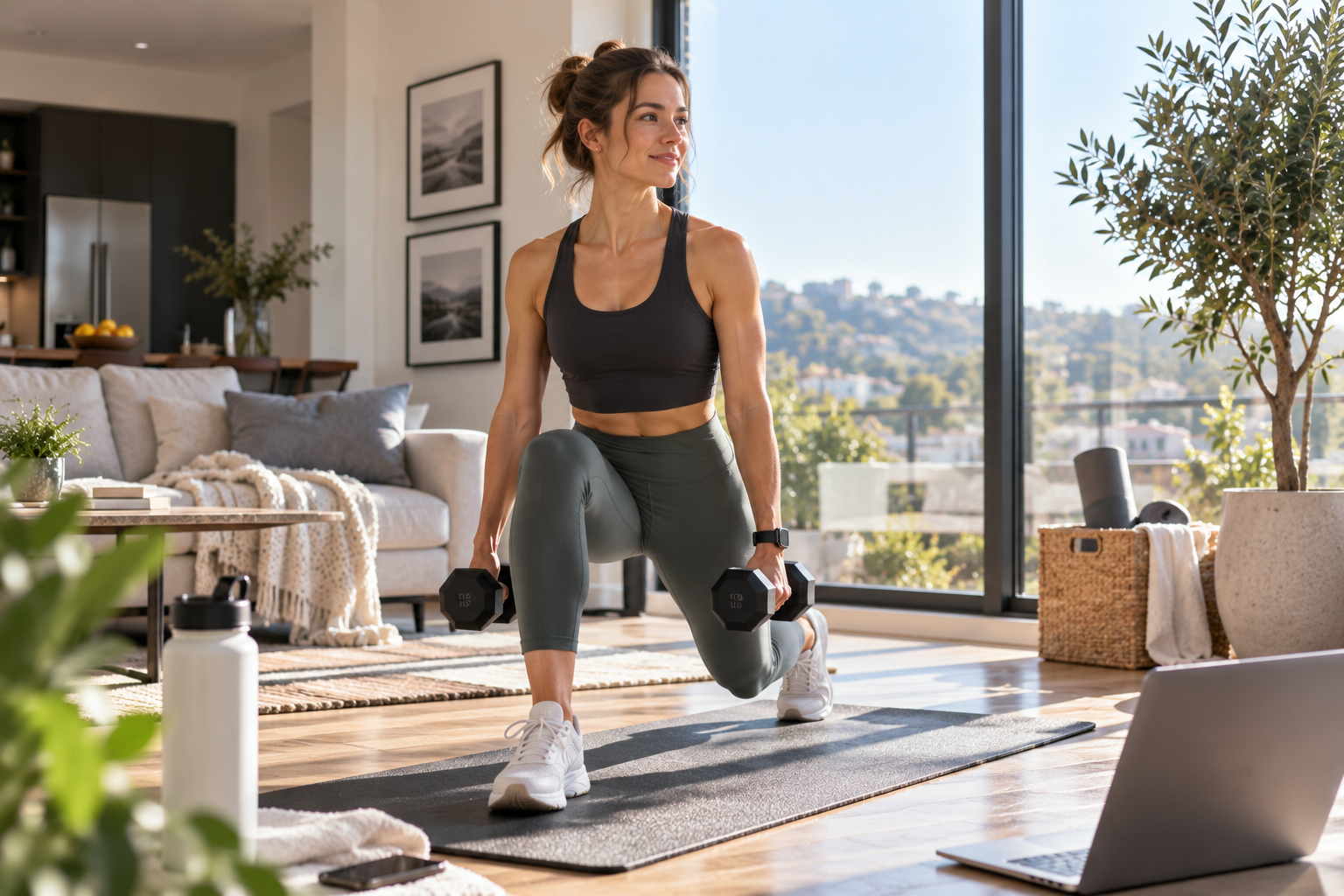
A squat or sit-to-stand movement
This trains the legs and hips and resembles the everyday action of getting up from a chair.
A pushing movement
Wall push-ups, incline push-ups, or regular push-ups can challenge the chest, shoulders, and arms at different difficulty levels.
A pulling movement
Resistance-band rows or appropriately performed dumbbell rows can train the muscles of the upper back and arms.
A hip-focused movement
Glute bridges or a carefully learned hip-hinge variation can train muscles around the hips and posterior chain.
A core-stability movement
Exercises such as bird dogs or other controlled trunk-stability movements can be incorporated according to your ability.
You do not need every possible exercise.
A small selection that covers the major muscle groups and that you can perform well is a much better starting point.
How Many Sets and Repetitions Should You Do?
This is where beginners often become overwhelmed.
Fortunately, you do not need a complicated mathematical formula.
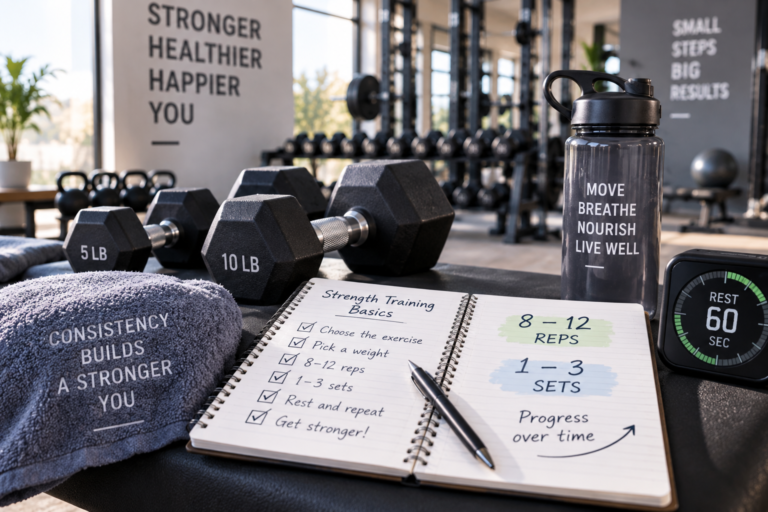
CDC guidance suggests 8–12 repetitions of a muscle-strengthening activity as one set, with at least one set being useful and two or three sets potentially providing additional benefits.
NIA provides similar guidance for muscle-strengthening exercise.
For a beginner, this means you can start conservatively.
You might perform one set of several exercises while you learn the movements. As your confidence and tolerance improve, you can gradually add another set or increase the resistance.
The important point is that the final repetitions should feel appropriately challenging while your technique remains controlled.
You should not need to turn every set into an all-out test of your limits.
How Hard Should Strength Training Feel?
Strength training needs to challenge your muscles to create a reason for them to adapt.
If you can perform an exercise endlessly without much effort, it may eventually become too easy to provide the same challenge.
On the other hand, choosing a resistance so difficult that your technique immediately breaks down is not a good beginner strategy either.
CDC describes muscle-strengthening activity as working to the point where performing another repetition becomes difficult without assistance.
Think of this as challenging but controlled.
As a beginner, prioritize learning the movement first.
Once you can perform an exercise confidently, gradually make it harder.
A Simple Beginner Strength Workout at Home
Here is an example of how those principles could come together.
It is not a universal prescription. Exercises should be adapted to your current abilities, mobility, experience, and health.
1. Chair Squat or Sit-to-Stand
Stand in front of a stable chair.
Lower yourself toward the chair under control, then stand back up.
A chair can provide a useful reference point for beginners.
2. Wall or Incline Push-Up
Place your hands against a wall or another stable elevated surface.
Keeping your body controlled, bend your elbows to bring your upper body toward the surface, then push away.
A more upright position generally makes the movement easier.
3. Resistance-Band Row
If you have an appropriate resistance band and a secure setup, use a rowing motion to work the upper back.
Focus on controlled movement rather than pulling as quickly as possible.
If you do not have the necessary equipment or cannot safely secure a band, choose another appropriate pulling exercise rather than improvising an unsafe anchor.
4. Glute Bridge
Lie on your back with your knees bent and feet supported on the floor.
Raise your hips under control, then lower them again.
Avoid turning the exercise into a race for repetitions.
5. Bird Dog
From a stable hands-and-knees position, gradually extend the opposite arm and leg while keeping your trunk controlled.
If the full movement is difficult, use a simpler variation.
For each exercise, a beginner might initially work within the general 8–12 repetition range where appropriate, beginning with one set and building gradually.
The goal of the first few weeks is not exhaustion.
It is learning.
Warm Up Before You Train
You do not need a 30-minute warm-up before a short home workout.
But moving from complete rest directly into demanding exercise is unnecessary.
NIA recommends warming up before strength activity, including beginning with less resistance, and advises gradually increasing physical activity over time.
A simple warm-up could include several minutes of easy walking, marching in place, gentle arm movements, and easier versions of the exercises you are about to perform.
Think of the warm-up as preparation rather than another workout.
What Is Progressive Overload?
Once your original routine becomes easy, your body needs a new challenge if you want to continue improving.
This is the basic idea behind progressive overload.
It sounds technical, but the principle is straightforward.
Over time, you might:
- Add a small amount of resistance
- Perform another repetition
- Add another set
- Progress to a more challenging exercise variation
- Improve the control and range of the movement where appropriate
NIA notes that gradual increases in weight, sets, repetitions, or training frequency can result in stronger muscles.
The word gradual matters.
You do not need to increase everything at once.
If you can comfortably perform your current routine with good technique, make one small adjustment and allow your body to adapt.
What If You Are Sore After Strength Training?
Some muscle soreness can occur when you perform an unfamiliar activity, particularly when you are new to resistance training.
But pain should not be treated as proof that a workout was effective.
NIA cautions that overdoing muscle-strengthening exercise can lead to exhaustion, joint soreness, muscle pain, or injury.
Sharp pain, significant joint pain, or symptoms that concern you are not something to push through simply to finish a workout.
Listen to your body and adjust when necessary.
There is no prize for making yourself so sore that you cannot move comfortably for several days.
Recovery Is Part of Strength Training
Training provides the challenge.
Recovery gives your body time to respond to that challenge.
That is why a sensible strength routine also includes adequate sleep, food, hydration, and recovery between demanding sessions.
NIA advises avoiding training the same muscle group on consecutive days to allow time for recovery.
Protein is also one component of a balanced diet that supports the body’s tissues.
If you are unsure how much you actually need, read How Much Protein Do You Need Each Day?.
And if sleep is the part of recovery you tend to neglect, see How Much Sleep Do You Really Need Each Night?.
Training and recovery are not competitors.
They are two parts of the same process.
Strength Training Does Not Replace Walking
It is easy to fall into the trap of choosing one type of exercise and assuming it covers everything.
It does not.
Current physical activity guidelines recommend both aerobic activity and muscle-strengthening activity for adults.
Walking can be a practical way to build aerobic activity into your week, while strength training challenges your muscles in a different way.
If walking is already part of your routine, you do not need to give it up when you start lifting.
Instead, build the two around each other.
For a simple walking target, see Is Walking 30 Minutes a Day Enough?.
A Realistic First Four Weeks
You do not need to transform your body in the first month.
A better goal is to become comfortable with strength training.
Week 1:
Learn a few basic exercises and practice them with light resistance or body weight.
Week 2:
Repeat the same movements and focus on making them more controlled and consistent.
Week 3:
If the exercises feel comfortable, consider adding a few repetitions, another set, or a small amount of resistance.
Week 4:
Review what feels too easy, appropriately challenging, or uncomfortable and adjust your routine accordingly.
This is intentionally simple.
Beginners often benefit more from becoming consistent with a few movements than from changing exercises every workout.
Common Mistakes When Starting at Home
Home workouts are convenient, but convenience can also make it tempting to rush.
One common mistake is doing too much during the first week because motivation is high.
Another is changing exercises constantly before you have had time to learn them.
Some people also focus only on the muscles they can see in the mirror while neglecting other major muscle groups.
And perhaps the most common mistake is believing that every workout must leave you exhausted.
It does not.
A productive routine should challenge you, but it should also be something you can recover from and repeat.
When Should You Get Professional Guidance?
For many generally healthy adults, gradually beginning moderate physical activity is reasonable.
However, individual circumstances matter.
If you have a chronic health condition, disability, significant joint problems, a recent injury, or uncertainty about which exercises are appropriate, professional guidance can help you adapt the routine to your needs. CDC specifically recommends that people with chronic conditions or disabilities consult an appropriate health professional or physical activity specialist about suitable types and amounts of activity.
NIA similarly advises talking with a doctor or physical therapist if you are uncertain about a particular movement.
Getting guidance is especially useful when pain, balance problems, previous injuries, or medical restrictions affect how you move.
You Don’t Need the Perfect Home Gym
It is easy to postpone strength training while waiting for the perfect setup.
A bench.
Adjustable dumbbells.
A rack.
More space.
Better shoes.
The right program.
Those things can be useful, but none of them creates consistency for you.
Start with what you have.
Learn a handful of movements.
Train regularly.
Then add equipment when it solves an actual problem — such as needing more resistance — rather than buying equipment first and hoping motivation follows.
The Daily Bearings Takeaway
Strength training at home does not need to be complicated.
Start with a small number of exercises that work the major muscle groups.
Learn the movements before worrying about heavy resistance.
For adults, current guidelines recommend muscle-strengthening activity on at least two days each week, and beginners can gradually increase resistance, repetitions, or sets as exercises become easier.
Combine strength training with regular aerobic activity, adequate nutrition, sleep, and recovery.
Most importantly, do not judge your first workout by how exhausted it makes you.
Judge your routine by whether you can perform it safely, progress gradually, and keep coming back to it.
You do not need to become a different person overnight.
You just need a reasonable place to begin.
Move. Breathe. Nourish.
References
Centers for Disease Control and Prevention (CDC) — Adult Activity: An Overview
Official guidance on aerobic and muscle-strengthening activity for adults.
CDC — Adult Activity Guidelines
Centers for Disease Control and Prevention (CDC) — What Counts as Physical Activity for Adults
Guidance on strength-training intensity, sets, repetitions, and major muscle groups.
CDC — What Counts as Physical Activity
National Institute on Aging (NIH) — Three Types of Exercise Can Improve Your Health and Physical Ability
Guidance on resistance exercise, progression, recovery, repetitions, and exercise safety.
NIA — Muscle-Strengthening Exercise Guidance
This article is for general educational purposes and is not a substitute for individualized medical advice. If you have a medical condition, disability, or concerns about beginning a new exercise or nutrition routine, consider discussing appropriate changes with a qualified healthcare professional.