How to Improve Mobility and Move More Freely
Knowing how to improve mobility is not just about becoming more flexible or being able to touch your toes.
Good mobility helps you move comfortably through the ranges of motion you use in everyday life — reaching overhead, bending down, turning, squatting, walking, climbing stairs, and getting up from the floor or a chair.
And unlike extreme flexibility, better mobility does not require turning yourself into a gymnast.
For most adults, the goal is much more practical: maintaining enough range of motion, strength, and control to move confidently and comfortably.
If you often feel stiff after sitting, notice that certain movements have become more difficult, or simply want your body to move better, a few consistent habits can make mobility work much more manageable.
What Does Mobility Actually Mean?
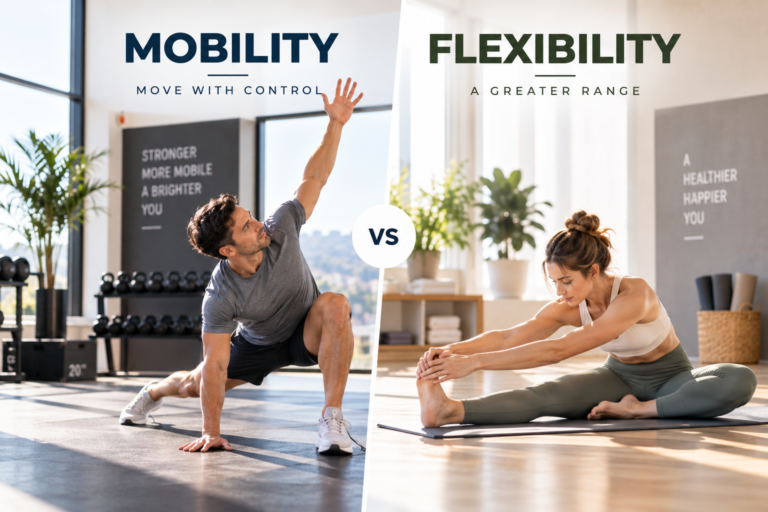
Mobility and flexibility are closely related, but they are not exactly the same thing.
Flexibility generally describes how far a joint and the surrounding tissues can move through a range of motion.
The National Institute on Aging describes flexibility as the ability of a joint to move through its full range of motion and notes that stretching can help maintain and improve it.
Mobility, in practical fitness terms, involves more than simply having that range available.
You also need enough strength, coordination, and control to use it.
Imagine someone who can pull a knee toward the chest while lying down but struggles to comfortably step onto a high stair while standing.
The available flexibility may be there, but using that range during a real movement also requires balance, strength, and control.
That is why an effective mobility routine should involve more than passive stretching.
Why Does Mobility Matter in Everyday Life?
Mobility becomes noticeable when you begin losing it.
Putting on socks may feel more awkward.
Looking over your shoulder may become uncomfortable.
Getting down to the floor — and back up again — may require more effort.
Reaching into a high cupboard or bending to pick something up may not feel as natural as it once did.
NIA notes that maintaining flexibility can make everyday activities such as reaching down to tie your shoes or unloading a dishwasher easier.
Mobility also interacts with the other parts of physical fitness.
You need sufficient joint motion to perform many strength exercises comfortably. You need strength to control that motion. And you need balance and coordination to use it while moving.
Rather than treating mobility as a separate fitness goal, it can be useful to think of it as one part of maintaining your overall ability to move.
If you want to understand why this becomes especially relevant over time, read Mobility as You Age: Why It Matters and How to Improve It.
Why Do You Feel Stiff?
Feeling stiff does not necessarily mean that your muscles have suddenly become permanently “tight.”
Stiffness can have many possible influences.
Spending long periods in the same position is one obvious example. After hours at a desk, in a car, or on a couch, simply moving again can feel noticeably different.
Your usual activity level, exercise habits, recovery, previous injuries, joint conditions, and individual anatomy can also affect how you move and how stiffness feels.
This is one reason there is no single stretch that everyone needs.
A better question is:
Which movements are difficult for you, and what do you need your body to do comfortably in daily life?
Someone who sits at a desk all day may have different mobility priorities from someone who gardens, plays tennis, lifts weights, or spends hours on their feet.
Your mobility routine should serve your life — not someone else’s social-media flexibility challenge.
Stretching Helps — But Mobility Is More Than Stretching
Stretching has a legitimate place in a mobility routine.
The Physical Activity Guidelines for Americans state that stretching exercises are effective for increasing flexibility and can make activities requiring flexibility easier.
But there is an important distinction.
The same guidelines note that flexibility activities by themselves do not count toward meeting the aerobic or muscle-strengthening recommendations, and evidence is unclear that stretching alone reduces the risk of activity-related injury.
In other words, stretching is useful — but it should not be treated as a replacement for walking, cardiovascular activity, or strength training.
A more complete approach combines:
Range of motion + strength + control + regular movement.
That combination is much closer to what most people actually want when they say they want to “move better.”
Start by Moving More Often
Before creating a complicated 30-minute mobility routine, consider something simpler:
Change positions more often.
If you spend much of the day sitting, adding small movement breaks gives your joints opportunities to move through different positions.
You might stand up.
Walk around the room.
Reach overhead.
Gently rotate your upper body.
Walk up a flight of stairs.
Perform a few controlled squats to a chair.
The purpose is not to turn every break into a workout.
It is simply to avoid spending most of the day in one position and then expecting a short evening stretch to compensate for it.
CDC’s current guidance emphasizes the broader principle of moving more and sitting less, noting that some physical activity is better than none.
Mobility is not something that only happens on an exercise mat.
It is influenced by how you move throughout the entire day.
Focus on the Areas You Actually Use
A practical mobility routine does not need dozens of exercises.
For many adults, several areas deserve particular attention because they are involved in common everyday movements.
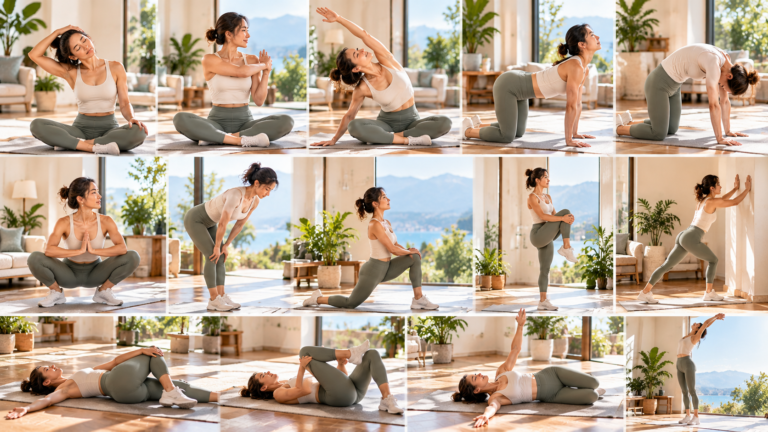
Ankles
Your ankles contribute to walking, climbing stairs, squatting, and maintaining balance.
One simple mobility drill is a controlled knee-over-toe movement while keeping the heel on the floor.
Move only through a comfortable range.
Hips
Your hips are involved in walking, sitting, standing, bending, and many strength-training movements.
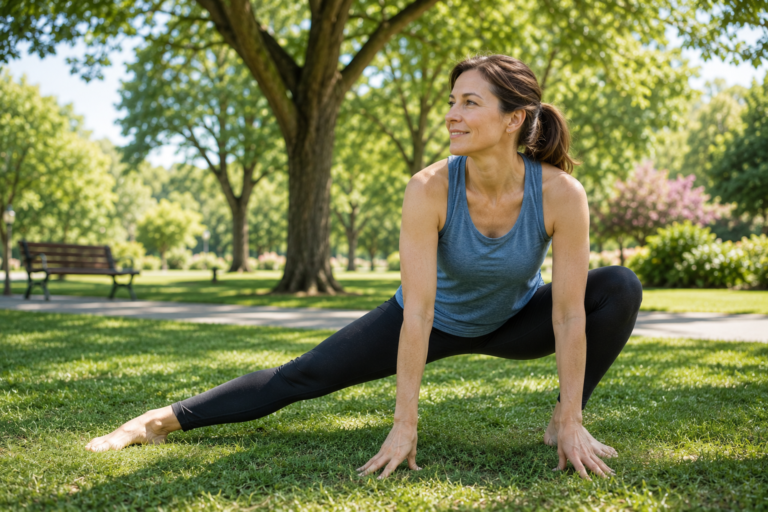
Gentle hip rotations, controlled lunges, or other movements that take the hips through comfortable ranges can be useful.
Upper Back
Modern life often involves considerable time sitting and working in front of screens.
Controlled upper-back rotation can help you practice a movement used when turning and reaching.
Shoulders
Reaching overhead, dressing, placing something on a shelf, and many exercises require shoulder motion.
Slow arm raises or controlled shoulder movements can help you explore your comfortable range without forcing it.
The goal is not to push every joint as far as possible.
The goal is to regularly use the movement you want to maintain.
Try a Simple 10-Minute Mobility Routine
You do not need an hour.
A short routine performed consistently can be easier to maintain than an ambitious routine you rarely complete.
Here is one example.
Minutes 1–2: Easy Movement
Walk around the room or march gently in place.
Let your body warm up before asking for larger ranges of motion.
Minutes 3–4: Ankle Mobility
Perform slow ankle movements or controlled knee-over-toe motions while keeping the heel supported.
Switch sides.
Minutes 5–6: Hip Mobility
Use gentle hip rotations or a comfortable lunge-based movement.
Avoid forcing yourself into a deep position.
Minutes 7–8: Upper-Back Rotation
From a comfortable seated or standing position, rotate the upper body slowly from side to side.
Keep the movement controlled.
Minutes 9–10: Shoulder Movement
Raise and lower your arms through a comfortable range, or perform gentle controlled shoulder circles.
This is only an example, not a prescription.
If a movement does not suit your body, modify it or choose another exercise that addresses the same general area.
Don’t Stretch Cold Muscles Aggressively
If you enjoy longer static stretches, timing matters.
NIA recommends stretching when muscles are warmed up and after endurance or strength exercise, while breathing normally and avoiding stretches that go so far that they hurt.
That does not mean you can never move when you are “cold.”
Gentle mobility movements can be part of a warm-up.
The distinction is between comfortable movement and immediately forcing a joint into an intense end-range stretch.
Start easy.
Let the range increase naturally as your body warms up.
Mobility work should not feel like a battle against your body.
Strength Can Improve the Mobility You Can Actually Use
This is one of the most overlooked pieces of mobility.
Suppose you improve the range of motion around a joint but do not have enough strength to control that range.
You may have become more flexible, but you have not necessarily improved your ability to use the movement during daily activity.
Strength training can complement mobility work by helping you control different positions.
A squat, for example, involves mobility at the ankles, knees, and hips — but it also requires muscular strength and coordination.
A controlled lunge combines joint motion with balance and strength.
This is why strength and mobility should not be treated as opposing goals.
They often support each other.
If you are new to resistance exercise, see How to Start Strength Training at Home.
What About Balance?
Balance is another part of comfortable movement that is easy to overlook.
NIA defines balance in terms of maintaining stability while still or moving and recommends balance exercises as part of an active lifestyle for older adults. Examples include standing on one foot, heel-to-toe walking, yoga, and tai chi.
You do not need to wait until balance becomes a problem to practice it.
For example, a simple supported single-leg stance can be incorporated into a mobility session.
Stand near a sturdy counter or wall.
Use support when necessary.
Safety matters more than making the exercise look difficult.
If you experience unexplained dizziness, repeated loss of balance, or falls, that is different from simply wanting to improve fitness. NIA advises medical evaluation when someone believes they may have a balance problem.
Should Mobility Exercises Hurt?
No.
You may feel mild tension or a stretching sensation, but sharp or significant pain is not a goal.
NIA specifically advises not stretching so far that it hurts.
The idea that you need to “push through” pain to become mobile is a poor rule.
Pain can have many causes, and an internet mobility routine cannot diagnose them.
If one particular movement consistently causes pain, swelling, numbness, significant weakness, or other concerning symptoms, stop treating it as something you simply need to stretch harder.
Consider discussing persistent or unexplained symptoms with an appropriate health professional.
How Often Should You Work on Mobility?
There is no need to make mobility another complicated number to chase.
Unlike the clear weekly recommendations for aerobic and muscle-strengthening activity, federal physical activity guidelines do not establish a comparable universal weekly target for flexibility work. The guidelines instead describe flexibility as an appropriate component of an overall physical activity program.
That gives you room to be practical.
Short mobility work can fit naturally:
- After a walk
- After strength training
- During a break from sitting
- As part of a warm-up
- At another convenient time when your body is already warm
Consistency is more useful than occasionally doing an extremely long session.
Five or ten minutes that becomes part of your routine may be more realistic than waiting for the perfect day to complete a 45-minute mobility workout.
How Do You Know If Your Mobility Is Improving?
You do not necessarily need special tests.
Look at the movements that matter to you.
Can you reach overhead more comfortably?
Does a squat feel less restricted?
Is getting down to the floor easier?
Can you turn to look behind you more comfortably?
Does climbing stairs feel smoother?
These practical changes can be more meaningful than trying to achieve an arbitrary flexibility standard.
You can also occasionally repeat the same controlled movement and compare how it feels over time.
Just remember that progress is not always linear.
Sleep, training, prolonged sitting, stress, and recent activity can all affect how your body feels on a particular day.
Common Mobility Mistakes
One mistake is assuming that more range of motion is always better.
You need enough mobility for the activities you want to perform — not necessarily the maximum possible range at every joint.
Another mistake is stretching aggressively because a joint feels stiff.
More force does not automatically create a better result.
A third mistake is doing mobility work while ignoring strength.
Range without control may not solve the movement problem you are trying to address.
And finally, many people spend long periods sitting but expect a few stretches to fix everything.
A better strategy combines mobility exercises with a generally active lifestyle.
Mobility, Walking, and Strength Work Better Together
A well-rounded movement routine does not force you to choose between mobility, walking, and strength training.
They serve different purposes.
Walking can help you accumulate aerobic activity.
Strength training challenges your muscles.
Mobility work helps maintain and practice comfortable ranges of motion.
Balance training develops stability and control.
Current U.S. physical activity guidance recommends aerobic and muscle-strengthening activity for adults, with balance activity additionally emphasized for older adults.
If walking is the foundation of your current routine, read Is Walking 30 Minutes a Day Enough?.
The goal is not to perform every type of exercise every day.
It is to build a week that gives your body different reasons to keep moving well.
When Should You Get Professional Guidance?
Most people can begin with gentle, comfortable movement and progress gradually.
But generic mobility exercises are not appropriate for every situation.
If you have a recent injury, chronic condition, significant joint problems, persistent pain, a disability that affects movement, or uncertainty about what is safe for you, individualized guidance may be useful.
CDC advises adults with chronic health conditions or disabilities to consult a health professional or physical activity specialist about appropriate types and amounts of activity.
A physical therapist or other qualified professional may also help determine whether what feels like a “mobility problem” is actually related to strength, pain, balance, an injury, or something else.
The Daily Bearings Takeaway
Learning how to improve mobility does not require memorizing dozens of stretches.
Start by moving more often throughout the day.
Practice comfortable ranges of motion at the ankles, hips, upper back, shoulders, and other areas that matter for your daily activities.
Use stretching to support flexibility, but do not rely on stretching alone.
Combine mobility with strength, aerobic activity, and balance work where appropriate.
Most importantly, do not chase extreme ranges of motion simply because they look impressive.
Useful mobility is the kind that helps you walk, reach, bend, turn, train, and live more comfortably.
A few minutes of thoughtful movement performed consistently can be a much better starting point than an elaborate routine you never repeat.
Move. Breathe. Nourish.
References
National Institute on Aging (NIH) — Three Types of Exercise Can Improve Your Health and Physical Ability
Covers flexibility, stretching, strength, balance, and exercise safety.
NIA — Exercise, Flexibility and Balance Guidance
U.S. Department of Health and Human Services — Physical Activity Guidelines for Americans, 2nd Edition
Official federal guidance covering flexibility as part of a broader physical activity program.
Physical Activity Guidelines for Americans
Centers for Disease Control and Prevention — Adult Activity: An Overview
Current guidance on aerobic and muscle-strengthening activity for adults.
CDC — Adult Physical Activity Guidelines
This article is for general educational purposes and is not a substitute for individualized medical advice. If you have a medical condition, disability, or concerns about beginning a new exercise or nutrition routine, consider discussing appropriate changes with a qualified healthcare professional.