Mobility vs. Flexibility: What’s the Difference and Why Does It Matter?
Mobility and flexibility are often used as if they mean the same thing.
They are closely related, but they are not identical.
You can be flexible without having excellent mobility. You can also improve the way you move without becoming dramatically more flexible.
Understanding the difference matters because many people respond to stiffness or restricted movement by doing only one thing:
Stretching more.
Stretching can certainly be useful. But comfortable, capable movement also depends on strength, balance, coordination, and your ability to control your joints through the range of motion you have.
That broader picture is where mobility comes in.
What Is Flexibility?
Flexibility generally describes how much range of motion is available around a joint or group of joints.
The National Institute on Aging describes flexibility as the ability of a joint to move through its full range of motion and explains that stretching can help maintain and improve flexibility.
Imagine lying on your back while someone gently raises your straight leg toward you.
How far your leg can move before you feel significant resistance gives some information about flexibility.
You are not necessarily controlling that entire movement yourself. The available range is the important part.
This is why stretching is commonly associated with flexibility.
Stretching places muscles and related tissues in lengthened positions and can help improve the range available to you.
What Is Mobility?
Mobility is a broader concept.
In practical fitness terms, mobility involves being able to move through a useful range of motion with control.
That can require several qualities working together:
- adequate flexibility
- muscle strength
- joint function
- balance
- coordination
- motor control
Consider a deep squat.
Someone might have enough hip and ankle flexibility to reach the bottom position when supported.
But can that person lower into the position under control?
Can they maintain their balance?
Can they stand back up comfortably?
Those questions involve more than flexibility alone.
They involve mobility.
This distinction becomes particularly useful when thinking about everyday movement rather than simply trying to become more flexible.
A Simple Way to Understand the Difference
Think about raising one leg.
If someone else can move your leg through a large range while you remain relaxed, that tells us something about your flexibility and passive range of motion.
If you can actively lift that leg, control it, maintain your posture, and use that range during movement, that tells us more about your active mobility.
Another example is reaching overhead.
You may be able to stretch your arm into a position.
But comfortably reaching into a high cabinet also requires shoulder movement, upper-back movement, strength, coordination, and control.
In everyday life, we rarely need flexibility in complete isolation.
We need usable movement.
Can You Be Flexible but Have Poor Mobility?
Yes.
This is one reason the distinction is useful.
A person may have considerable passive range of motion but lack the strength or control to use that entire range effectively.
Imagine someone who can pull their knee toward their chest while lying down but struggles to raise the knee nearly as high while standing.
The available passive range exists.
But actively controlling that range is more difficult.
That does not necessarily mean something is wrong. It simply illustrates that having range of motion and controlling that range are different qualities.
This is why endlessly stretching a body part is not always the complete answer to a movement limitation.
Can You Have Good Mobility Without Being Extremely Flexible?
Absolutely.
You do not need gymnast-level flexibility to move well.
Most people need enough range of motion to comfortably perform the activities that matter in their lives.
That might include walking, climbing stairs, reaching overhead, bending down, turning, getting in and out of a car, exercising, gardening, or playing with children.
The goal is not necessarily maximum flexibility.
It is useful flexibility combined with control.
That is an important distinction because pursuing extreme range of motion offers little practical value if that range is not necessary for your activities.
Why Do People Feel Stiff?
Feeling stiff does not always mean you simply need more stretching.
Stiffness can have several possible contributors.
You may have been sitting in one position for a long time.
A particular movement may be unfamiliar.
Muscles may be fatigued after exercise.
Your body may not yet be comfortable controlling a particular range.
Strength around a joint may be limited.
Or your actual range of motion may be restricted.
This is why the sensation of stiffness and a measurable limitation in flexibility are not necessarily the same thing.
Sometimes a few minutes of easy movement can make you feel considerably less stiff even though your underlying flexibility has not suddenly transformed.
That is useful information.
Stretching Still Matters
None of this means stretching is unnecessary.
Stretching is one tool for maintaining or improving flexibility.
The National Institute on Aging recommends stretching when muscles are warmed up, breathing normally while stretching, and avoiding stretching so far that it becomes painful.
Stretching can be especially useful when a limited range of motion makes a particular activity uncomfortable or difficult.
The mistake is not stretching.
The mistake is assuming that every movement problem can be solved by stretching alone.
Sometimes improving usable movement requires adding strength and control.
Strength and Mobility Work Together
Strength training may not immediately come to mind when people think about mobility.
But strength helps you control your body.
Consider standing up from a low chair.
Hip and ankle mobility matter.
But so does leg strength.
Consider walking down stairs.
Joint range matters.
But controlling your body as you lower yourself matters too.
Consider reaching down to pick up a bag.
Being able to bend is useful.
Being strong enough to control the movement and lift the bag is equally important.
This is why mobility and strength should not be treated as opposing goals.
They often support each other.
If you are beginning resistance training, our guide How Many Reps and Sets Should You Do for Strength Training? explains how to choose a practical number of repetitions and sets without making your workouts unnecessarily complicated.
Active Range of Motion Matters
Another useful distinction is between passive and active range of motion.
Passive range is the movement available when an outside force helps move you.
Active range is the movement you can produce and control yourself.
For example, you might use your hands to pull your knee close to your chest.
That demonstrates passive range.
Now release your hands and try lifting the knee toward the same position using only your muscles.
That demonstrates active control.
The two positions may not be identical.
Mobility training often aims to make more of your available range usable and controllable.
That is one reason controlled joint movements can complement traditional stretching.
Mobility Training Does Not Need to Look Complicated
Social media sometimes makes mobility training look like an advanced collection of unusual exercises.
It does not need to be.
Simple movements performed slowly and with control can be useful.
For the ankles, you might gently move the knee forward over the foot while keeping the heel comfortably grounded.
For the hips, controlled hip rotations or comfortable squat variations can expose the joint to different positions.
For the upper back, gentle thoracic rotations can help you practice rotational movement.
For the shoulders, controlled arm raises and rotations can explore comfortable overhead range.
The goal is not to achieve the largest possible range immediately.
The goal is to gradually develop comfortable, controlled movement.
For more practical exercises and everyday strategies, see How to Improve Mobility and Move More Freely.
Don’t Force Range of Motion
More range is not automatically better.
And pain is not proof that mobility training is working.
NIA advises against stretching so far that it hurts.
The same principle applies more broadly to mobility work.
A mild stretching sensation can occur during certain movements. But sharp pain, significant joint pain, or a feeling that something is mechanically blocked should not simply be forced through.
If a movement repeatedly causes pain, or your range of motion changes suddenly without an obvious explanation, individualized evaluation may be more appropriate than simply adding more stretches.
Mobility Is Specific
Someone can have excellent shoulder mobility and limited ankle mobility.
Another person may comfortably squat but struggle to rotate through the upper back.
Mobility is not a single score that describes your entire body.
It is specific to joints, movements, and tasks.
This matters when choosing exercises.
If your goal is to comfortably reach overhead, spending all your mobility time stretching your hamstrings is unlikely to directly address that goal.
Your mobility work should reflect the movements you actually want to improve.
Everyday Movement Can Be Mobility Practice
Mobility does not have to happen only during a dedicated 20-minute routine.
Everyday movement provides opportunities to use your available range of motion.
You squat when sitting down.
You rotate when reaching behind you.
You reach overhead when placing something on a shelf.
You use ankle motion while walking and climbing stairs.
You bend and stabilize your body while gardening or cleaning.
Regular physical activity exposes your body to different positions and movement demands.
The CDC’s physical activity guidance for adults emphasizes that some physical activity is better than none and encourages adults to move more and sit less. Current guidance recommends at least 150 minutes of moderate-intensity aerobic activity each week, along with muscle-strengthening activity on at least two days.
Dedicated mobility exercises can be helpful, but they work best as part of an active life rather than as a substitute for one.
Mobility Becomes Especially Important With Age
Maintaining useful movement can become increasingly important as the years pass.
Mobility affects many activities that help people continue living independently—from walking and climbing stairs to shopping, household tasks, and moving around the community.
Research highlighted by the National Institute on Aging on maintaining mobility and preventing disability has examined programs combining walking, strength, flexibility, and balance training to help preserve physical function in older adults.
That is why our approach at Daily Bearings treats mobility as part of a larger system.
Walking matters.
Strength matters.
Balance matters.
Flexibility matters.
And the ability to combine those qualities during everyday movement matters.
Our earlier guide Mobility as You Age: Why It Matters and How to Improve It explores that relationship in greater detail.
What About Balance?
Balance is another physical quality that overlaps with mobility but is not identical to it.
Balance involves maintaining stability while standing still or moving.
The CDC physical activity recommendations include balance activities for adults age 65 and older, alongside aerobic and muscle-strengthening activity.
Balance practice does not necessarily need to be complicated.
Depending on your abilities, examples might include standing on one foot with stable support nearby, controlled sit-to-stand movements, tai chi, or other activities that safely challenge stability.
Mobility becomes more useful when you can control your body within the available range.
Balance contributes to that control.
Should You Stretch Before Exercise?
This question often appears whenever flexibility is discussed.
The answer depends partly on what you mean by stretching and what activity you are about to perform.
For many workouts, a gradual warm-up using movements similar to the upcoming activity is practical.
NIA recommends warming up before muscle-strengthening activity with easier or lighter versions of the exercise and advises stretching when muscles are warmed up.
Before a strength workout, for example, you might begin with easier versions of the exercises you are about to perform.
Before brisk walking, you might begin at an easier pace.
You do not necessarily need a long flexibility session before every workout.
How Often Should You Work on Mobility?
There is no single universal mobility schedule that every adult needs to follow.
The federal guidelines provide specific weekly targets for aerobic and muscle-strengthening activity, but mobility and flexibility practice can be incorporated according to your needs, activities, and limitations.
A practical approach is to include small amounts regularly.
That could mean a few controlled movements in the morning, mobility work during a warm-up, stretching after activity, short movement breaks during the workday, or a dedicated session when you have more time.
Consistency is usually more useful than occasionally forcing yourself through an extreme flexibility session.
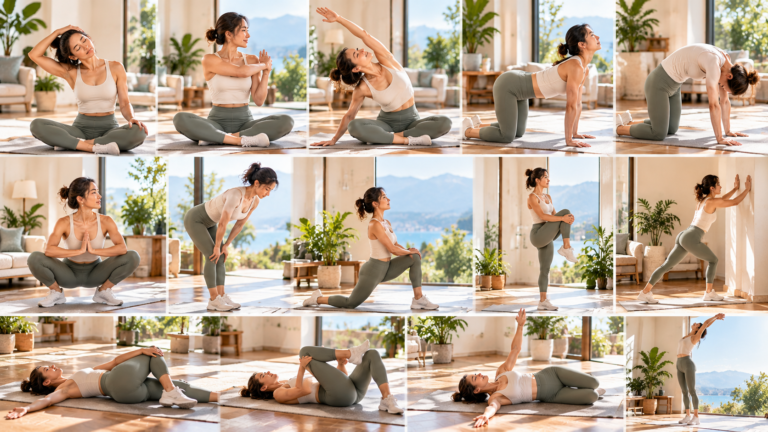
A Simple Mobility and Flexibility Routine
You do not need a complicated program to begin practicing movement.
Start with about two minutes of easy movement. Walk around or perform gentle full-body movements to warm up.
Spend about one minute on your ankles, moving each ankle through a comfortable range.
Use another two minutes for your hips, with controlled hip movements or comfortable squat patterns.
Spend about two minutes rotating through your upper back, moving gently from side to side without forcing the range.
Then use approximately one minute for your shoulders, moving the arms through comfortable circles or overhead reaches.
Finish with about two minutes of gentle stretching for areas where additional flexibility work feels useful.
That gives you roughly ten minutes of movement practice without turning mobility into another complicated fitness program.
The exact exercises and range should be adjusted to your abilities and goals.
Don’t Measure Success by How Far You Can Stretch
Mobility progress may look different from what you expect.
Perhaps you can reach a shelf more comfortably.
Maybe squatting down feels easier.
Perhaps turning to look behind you requires less effort.
You may feel steadier stepping over an obstacle.
Or you may find it easier to get down to the floor and back up.
These can all represent meaningful improvements in usable movement.
The goal is not to win a stretching contest.
The goal is to make your available movement useful for your life.
The Daily Bearings Takeaway
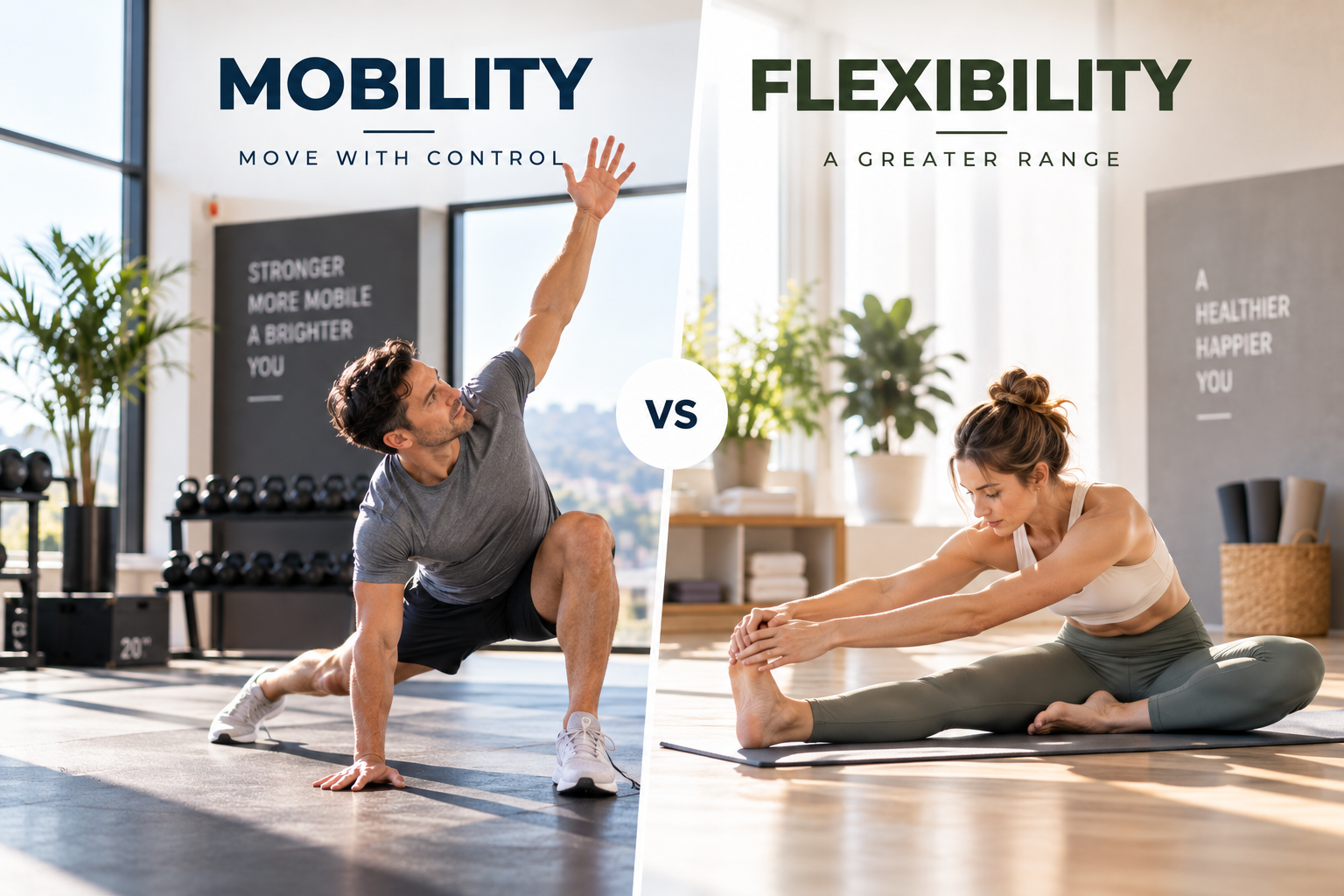
So, what is the difference between mobility and flexibility?
Flexibility primarily describes the range of motion available around a joint.
Mobility is broader. It involves being able to use and control movement effectively.
Flexibility can support mobility, but mobility also depends on strength, balance, coordination, and control.
That is why stretching alone is not always the complete solution to stiffness or restricted movement.
Stretch when it is useful.
Strengthen your body.
Practice controlled movement.
Stay active.
And focus less on achieving extreme positions and more on being able to move comfortably through the positions your life actually requires.
Move. Breathe. Nourish.
This article is for general educational purposes and is not a substitute for individualized medical advice. If you have a medical condition, disability, or concerns about beginning a new exercise or nutrition routine, consider discussing appropriate changes with a qualified healthcare professional.
References
National Institute on Aging — Three Types of Exercise Can Improve Your Health and Physical Ability
Guidance on flexibility, stretching, strength, balance, and exercise safety.
CDC — Adult Activity: An Overview
Current recommendations for aerobic and muscle-strengthening activity in adults.
National Institute on Aging — Maintaining Mobility and Preventing Disability Are Key to Living Independently as We Age
Research and background on physical activity, mobility, physical function, and independent living with age.