How Much Exercise Do You Need Each Week?
How much exercise do you need each week? The answer is more flexible than many people think.
You do not necessarily need to exercise every day. You do not need to spend hours in the gym. And you do not need to complete every minute of activity in long, structured workouts.
For most adults, a useful goal is to accumulate 150 to 300 minutes of moderate-intensity aerobic activity each week, or 75 to 150 minutes of vigorous-intensity aerobic activity, or an equivalent combination of the two.
Adults should also include muscle-strengthening activities on at least two days each week.
Those numbers can sound demanding at first. But they describe a weekly total, not a rigid daily prescription.
Walking, cycling, swimming, dancing, hiking, recreational activities, and many other forms of movement can contribute.
The goal is not to create a perfect exercise schedule.
It is to build a realistic pattern of movement that supports your health and can continue for years.
How Much Exercise Do You Need Each Week?
For most adults, the general weekly recommendation is:
150–300 minutes of moderate-intensity aerobic activity
or
75–150 minutes of vigorous-intensity aerobic activity
or
an equivalent combination of moderate and vigorous activity
plus
muscle-strengthening activities on at least 2 days each week.
The important word here is weekly.
You do not have to complete exactly 30 minutes every day.
You can distribute your activity across the week in a way that fits your schedule, preferences, and physical ability.
That flexibility makes the recommendation much more practical than it may initially appear.
What Counts as Moderate-Intensity Exercise?
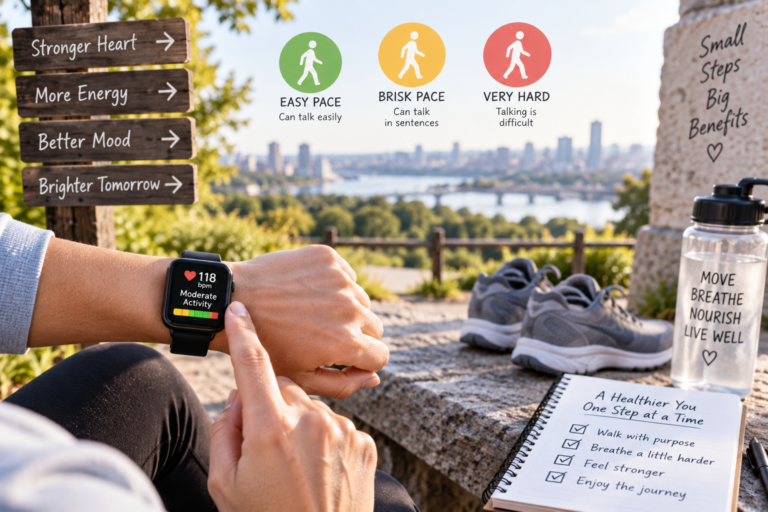
Moderate-intensity activity makes your heart beat faster and your breathing become more noticeable, but it should not feel like an all-out effort.
Examples may include:
- Brisk walking
- Recreational cycling
- Water aerobics
- Dancing
- Active yard work
- Some forms of hiking
- Other activities that noticeably increase your breathing and heart rate
One of the simplest ways to estimate intensity is the talk test.
During moderate-intensity activity, you can generally still carry on a conversation, although your breathing is clearly harder than when you are resting.
You do not necessarily need a smartwatch or heart-rate monitor to recognize this level of effort.
For many adults, brisk walking is one of the easiest ways to reach it.
If you are unsure what brisk walking should actually feel like, see What Is Brisk Walking? How Fast Should You Walk?.
What Counts as Vigorous Exercise?
Vigorous activity requires substantially more effort.
Examples may include:
- Running
- Fast cycling
- Swimming laps at a challenging pace
- Strenuous hiking
- Fast stair climbing
- High-intensity recreational sports
During vigorous activity, your breathing becomes much harder and speaking continuously is more difficult.
You may only be able to say a few words before needing another breath.
Because vigorous exercise places greater demands on the body, the recommended weekly duration is lower.
Approximately 75 to 150 minutes of vigorous aerobic activity per week can fall within the recommended range for adults.
You can also combine moderate and vigorous activity instead of choosing only one.
For example, someone might briskly walk several days each week and include one shorter, more vigorous cycling session.
Does Walking Count as Exercise?
Yes.
Walking can absolutely contribute toward your weekly exercise target, particularly when you walk at a moderate intensity.
A relaxed stroll still provides movement and can help break up sedentary time.
But a brisk walk is more likely to raise your heart rate and breathing enough to qualify as moderate-intensity aerobic activity.
This is one reason walking is such a practical foundation for a health-focused exercise routine.
It requires little equipment, can be adjusted to different fitness levels, and can often be incorporated into everyday life.
You also do not need to reach 10,000 steps before walking becomes worthwhile.
The more useful question is whether you are moving regularly and accumulating enough meaningful activity across the week.
You Don’t Have to Exercise for 30 Minutes at Once
A common misconception is that exercise only counts when you complete a long uninterrupted workout.
That can make physical activity seem much harder to fit into a busy life.
Instead, think about your total movement across the day and week.
For example, you might take:
A 15-minute brisk walk before work.
A 10-minute walk after lunch.
Another 10-minute walk after dinner.
Those periods all contribute to your overall activity.
This is especially useful for people who struggle to find a large block of uninterrupted exercise time.
A busy day does not automatically have to become an inactive day.
Short periods of movement can make a meaningful difference when they become part of a consistent routine.
What Could 150 Minutes Actually Look Like?
There is no single correct schedule.
One person might prefer:
30 minutes × 5 days
Another might do:
50 minutes × 3 days
Someone else may accumulate shorter periods throughout several days.
For example:
Monday: 30-minute brisk walk
Tuesday: Strength training
Wednesday: 30-minute brisk walk
Thursday: 20-minute brisk walk
Friday: Strength training + 20-minute walk
Saturday: 50-minute walk, bike ride, or hike
Sunday: Rest or light everyday movement
That would provide 150 minutes of aerobic activity while also including two strength-training days.
It is only an example.
Your schedule does not need to look exactly like this.
Do You Need to Exercise Every Day?
No.
You do not need seven formal workouts every week to meet general physical activity recommendations.
Rest days can be completely appropriate.
But a rest day from structured exercise does not need to mean spending the entire day sitting.
There is an important distinction between exercise and everyday movement.
Even on a day without a workout, you might:
Walk the dog.
Do household chores.
Go shopping.
Garden.
Take the stairs.
Walk during a phone call.
Play outside with children or grandchildren.
Take a short walk after dinner.
These activities may not feel like traditional exercise, but they help create a more active lifestyle.
If you spend much of your day sitting, our guide How to Sit Less and Move More Throughout the Day explains practical ways to add movement without turning your entire day into a workout.
Don’t Forget Strength Training
Aerobic exercise is only one part of a well-rounded activity plan.
Adults should also perform muscle-strengthening activities on at least two days each week.
These activities should challenge the major muscle groups, including the legs, hips, back, abdomen, chest, shoulders, and arms.
Strength training might include:
- Dumbbells
- Resistance bands
- Weight machines
- Bodyweight exercises
- Certain forms of yoga
- Other exercises that challenge your muscles against resistance
Strength training does not have to mean bodybuilding.
For everyday health, its purpose can be much more practical.
Strength helps you:
Get out of a chair.
Climb stairs.
Carry groceries.
Lift household objects.
Maintain physical function.
Continue participating in activities you enjoy.
If you are unsure how often to train, read How Many Days a Week Should You Strength Train?.
And if you are exercising at home, How to Start Strength Training at Home provides a beginner-friendly starting point.
How Hard Should Strength Training Feel?
You do not need to use the heaviest weights possible.
The resistance should be challenging enough that your muscles have to work, while still allowing you to perform the exercise with controlled technique.
A weight that is far too light may provide little challenge.
A weight that is too heavy may cause your technique to break down.
Finding an appropriate middle ground is more useful than simply chasing heavier numbers.
For a more detailed explanation, see How Heavy Should You Lift for Strength Training?.
Your resistance can gradually increase as you become stronger.
Progress does not need to happen every workout.
What About Balance?
Balance deserves attention too, particularly as we get older.
For older adults, physical activity recommendations include balance-focused activity in addition to aerobic exercise and muscle strengthening.
Balance work can help support the physical abilities used in everyday life.
Depending on your current ability, examples might include:
- Standing on one foot with appropriate support nearby
- Heel-to-toe walking
- Tai chi
- Controlled stepping exercises
- Certain yoga movements
- Exercises that safely challenge stability
You do not necessarily need a long separate balance workout.
Small amounts of balance practice can be incorporated into a broader routine.
If this is an area you want to improve, see How to Improve Balance as You Age.
Where Does Mobility Fit?
Mobility has a different role from aerobic exercise and strength training.
It does not replace either one.
Instead, mobility can help you maintain comfortable movement through useful ranges of motion.
Your ankles, hips, spine, and shoulders all contribute to everyday movements such as walking, reaching, bending, squatting, and climbing stairs.
You do not necessarily need an hour-long stretching session.
A short routine can regularly move important joints through comfortable ranges.
Our 10-Minute Daily Mobility Routine for Better Movement is designed to make this easier to incorporate into everyday life.
Think of mobility as something that supports your ability to move—not as a substitute for movement itself.
Is 150 Minutes a Minimum or a Maximum?
The lower end of the general guideline—150 minutes of moderate-intensity activity—is an important target, but it is not a maximum.
Adults may gain additional health benefits by gradually moving toward 300 minutes of moderate-intensity aerobic activity per week, provided that the amount is appropriate for their health, conditioning, and recovery.
But this does not mean everyone needs to immediately aim for 300 minutes.
If you currently do very little exercise, 300 minutes can be an unnecessary and discouraging starting point.
Start from where you are.
Build gradually.
Once 150 minutes becomes manageable, you can decide whether increasing your activity makes sense for your goals and lifestyle.
More exercise is not automatically better if it leaves you constantly exhausted, sore, or unable to recover.
What If You Currently Do No Exercise?
This is where the guidelines should become encouraging rather than intimidating.
If you currently do very little physical activity, do not let the number 150 convince you that anything less is pointless.
Some activity is better than none.
You might begin with a 10-minute walk.
Repeat it several times during the week.
When that feels manageable, increase one walk to 15 minutes.
Later, you might add another day.
The progression could look like this:
Week 1: 10 minutes × 3 days.
Week 2: 15 minutes × 3 days.
Week 3: 20 minutes × 3 days.
Week 4: Add another short walking day.
There is nothing magical about this exact progression.
The point is to create a starting level that feels realistic.
Consistency gives you something to build on.
A Simple Beginner Weekly Exercise Plan
If you want a straightforward starting structure, your week might look something like this:
Monday — Brisk Walking
30 minutes at a moderate pace.
Tuesday — Strength Training
A simple full-body resistance workout.
Wednesday — Brisk Walking
30 minutes.
Thursday — Light Movement or Rest
Everyday walking, household activity, or a short mobility routine.
Friday — Strength + Walking
Strength training followed by a 20-minute walk.
Saturday — Longer Moderate Activity
A 40-minute walk, bike ride, swim, hike, or another activity you enjoy.
Sunday — Brisk Walking
30 minutes.
That provides approximately 150 minutes of aerobic activity, two strength sessions, and room for recovery.
Again, this is an example—not a prescription.
You can rearrange the days according to your schedule.
Exercise and Everyday Movement Work Together
A person can complete a 30-minute workout and still spend most of the remaining day sitting.
That does not erase the benefits of the workout.
But it does show why structured exercise and everyday movement should be considered together.
Look for small opportunities to move.
Park a little farther away when practical.
Take the stairs.
Stand up periodically while working.
Walk while talking on the phone.
Take a short walk after eating.
Do household tasks.
Carry groceries.
Spend time outside.
These movements may seem small individually.
Repeated throughout the week, they help create a lifestyle in which movement is normal rather than something confined to a workout.
Not Every Workout Needs to Be Hard
A sustainable exercise week usually contains different levels of effort.
Some workouts may challenge you.
Others may be relatively easy.
A brisk walk does not need to leave you exhausted.
A mobility session may feel gentle.
Strength training may challenge your muscles without leaving you unable to function the next day.
Trying to make every workout extremely difficult can make exercise harder to sustain.
For general health, you do not need to prove how hard you can exercise every day.
You need a routine you can repeat.
Exercise Should Fit Your Life
The best weekly exercise program is not necessarily the one that looks most impressive.
It is the one you can realistically maintain.
If you dislike running, you do not need to run simply because other people do.
You might prefer:
Walking.
Cycling.
Swimming.
Dancing.
Hiking.
Fitness classes.
Recreational sports.
Home workouts.
A combination of several activities.
Variety can also make movement more enjoyable and reduce the feeling that exercise is another obligation.
Your exercise routine should support your life—not take it over.
Your Weekly Target Can Change
Your activity does not have to look identical every week.
Some weeks may be busier.
Travel may interrupt your routine.
Work responsibilities may increase.
You may sleep poorly.
You may need more recovery.
Other weeks may provide more opportunities for activity.
Instead of viewing one imperfect week as failure, look at your habits over time.
A sustainable routine allows some flexibility.
The goal is to repeatedly return to movement.
Exercise as You Get Older
Physical activity remains important as we age, but the way you exercise may change.
Recovery may require more attention.
Balance may become more relevant.
Maintaining strength and mobility may become increasingly important for everyday independence.
The goal does not have to be performing the same workouts you did decades ago.
A better goal is maintaining the physical abilities that allow you to continue living actively.
Walking.
Carrying things.
Climbing stairs.
Traveling.
Playing with family.
Participating in hobbies.
Moving confidently through your community.
These are meaningful outcomes of staying physically active.
When Should You Be More Cautious?
General physical activity guidelines are designed for broad populations.
Individual circumstances can be different.
If you have a medical condition, disability, significant mobility limitation, unexplained chest discomfort, unusual shortness of breath, dizziness, or other concerning symptoms, your exercise plan may need to be individualized.
That does not necessarily mean avoiding physical activity.
It may mean choosing appropriate activities, intensity, and progression with professional guidance.
The goal is to find a safe way to remain as active as your circumstances allow.
Don’t Turn the Guidelines Into a Scorecard
Health recommendations can sometimes become another source of pressure.
You completed 140 minutes instead of 150.
You missed one strength workout.
You had a busy week.
That does not mean your exercise routine failed.
Guidelines provide useful targets at the population level.
Your real-life routine will naturally fluctuate.
Instead of asking whether every week was perfect, ask:
Am I moving more consistently than I used to?
Am I maintaining or improving my strength?
Can I perform everyday activities comfortably?
Is my routine realistic enough to continue?
Those questions can be more useful than obsessing over a single number.
The Daily Bearings Takeaway
So, how much exercise do you need each week?
For most adults, a strong general target is 150 to 300 minutes of moderate-intensity aerobic activity per week, or 75 to 150 minutes of vigorous activity, or an equivalent combination of the two.
Add muscle-strengthening activity on at least two days each week, and as you get older, include activities that support balance as well.
But remember what those numbers are for.
They are guidelines—not a test.
You can spread exercise throughout the week.
You can use shorter periods of activity.
Brisk walking can count.
Strength training matters.
Mobility can support comfortable movement.
And if you currently do very little, you do not have to reach the full target immediately.
Start with an amount you can repeat.
Build gradually.
Then focus on creating a pattern of movement that can remain part of your life.
Move. Breathe. Nourish.
This article is for general educational purposes and is not a substitute for individualized medical advice. If you have a medical condition, disability, or concerns about beginning a new exercise or nutrition routine, consider discussing appropriate changes with a qualified healthcare professional.
References
Centers for Disease Control and Prevention — Adult Activity: An Overview
https://www.cdc.gov/physical-activity-basics/guidelines/adults.html
U.S. Office of Disease Prevention and Health Promotion — Physical Activity Guidelines for Americans
https://odphp.health.gov/our-work/nutrition-physical-activity/physical-activity-guidelines/current-guidelines/top-10-things-know
National Institute on Aging — Three Types of Exercise Can Improve Your Health and Physical Ability
https://www.nia.nih.gov/health/four-types-exercise-can-improve-your-health-and-physical-ability