What Is Brisk Walking? How Fast Should You Walk?
Walking is simple.
But the phrase brisk walking can make it sound more complicated than it really is.
How fast is “brisk”?
Does it mean 3 miles per hour? Four miles per hour?
Do you need to track your heart rate?
And if you walk more slowly, does your walk still count?
These are reasonable questions because public health recommendations frequently use brisk walking as an example of moderate-intensity physical activity.
But brisk walking is not defined by one perfect speed that applies to everyone.
Your fitness level, age, terrain, weather, body size, health, and even the slope of the road can influence how hard a particular walking pace feels.
A better approach is to understand intensity rather than chase a specific number on your watch.
What Does Brisk Walking Mean?
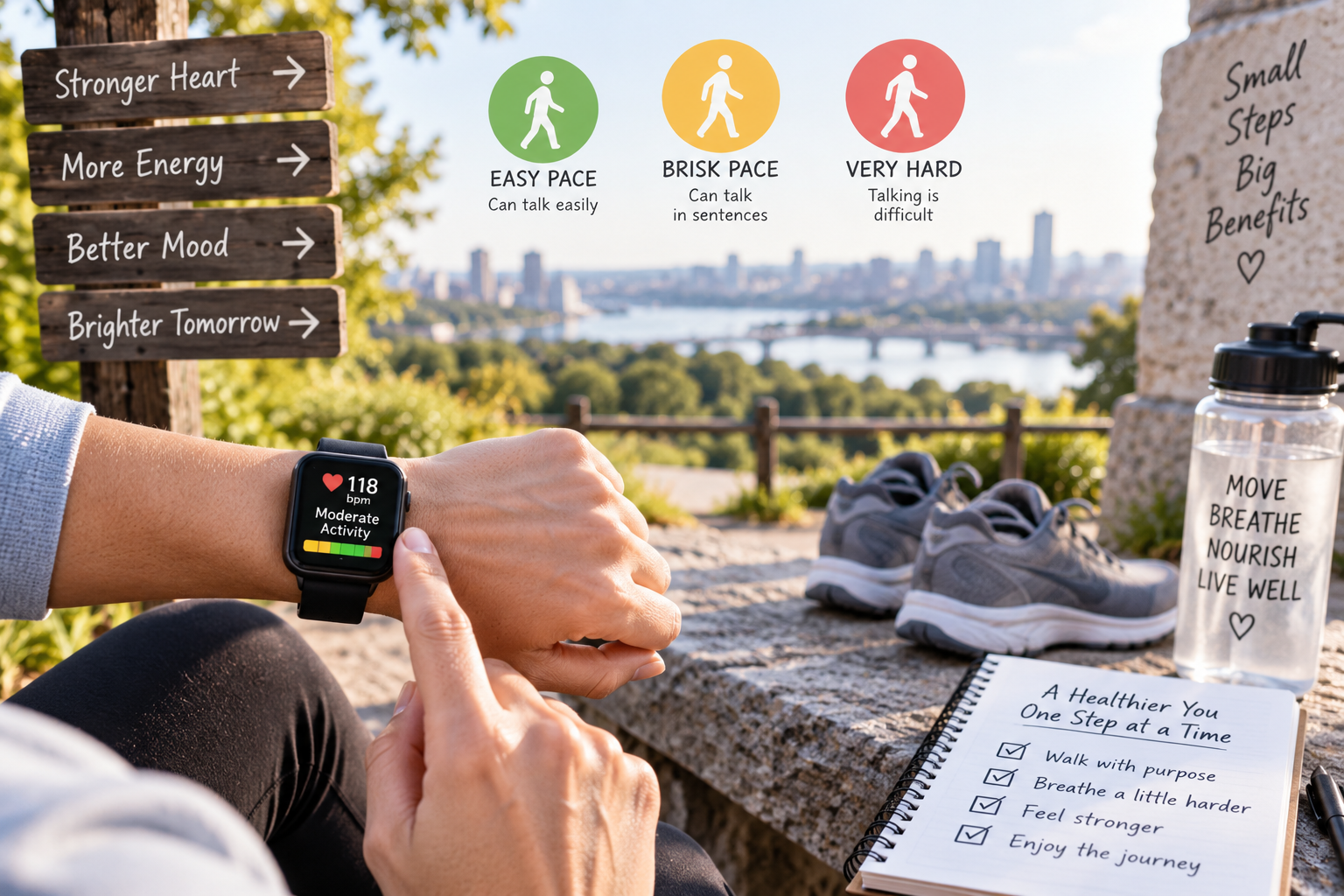
Brisk walking generally means walking at a pace that noticeably increases your breathing and heart rate while still allowing you to continue the activity.
In the Physical Activity Guidelines for Americans, brisk walking is listed as an example of moderate-intensity aerobic activity. The guidelines recommend that adults accumulate 150 to 300 minutes of moderate-intensity aerobic activity each week, or an equivalent amount of vigorous activity or a combination of the two.
The important word here is moderate.
Brisk walking should feel more purposeful than strolling casually through a store, but it does not need to feel like running.
You are moving with intention.
Your breathing becomes faster.
Your heart works harder.
You feel warmer.
But you are not necessarily gasping for air.
That is the general zone we are trying to identify.
There Is No Universal Brisk-Walking Speed
You may see brisk walking described online using a specific speed.
That can be useful as a rough reference, but it should not become a rule.
Imagine two people walking next to each other at exactly the same speed.
One is a well-trained runner.
The other has recently started exercising after years of inactivity.
The same walking speed may feel easy to the first person and moderately challenging to the second.
Now put both people on a steep hill.
The intensity changes again—even if their speed decreases.
This illustrates an important principle:
Exercise intensity is partly relative to the person doing the exercise.
A pace that is brisk for you may not be brisk for someone else.
That is why practical intensity measures can often be more useful than speed alone.
Use the Talk Test
One of the easiest ways to judge walking intensity requires no watch, app, or heart-rate monitor.
Try talking.
NIA explains that during moderate-intensity aerobic activity, your breathing and heart rate increase, but you should generally still be able to carry on a conversation. During vigorous activity, speaking more than a few words without pausing for breath becomes difficult.
This gives you a simple real-world test.
Easy walking
You can talk comfortably and your breathing has barely changed.
Brisk or moderate walking
You are breathing harder, but you can still speak in sentences and have a conversation.
Very hard or vigorous effort
Talking becomes difficult and you need frequent pauses for breath.
You do not need to test yourself constantly.
After using this method a few times, you will usually develop a reasonable sense of what moderate effort feels like.
Brisk Walking Is More Than Moving Your Legs Faster
People sometimes try to walk faster by dramatically lengthening their stride.
That is not necessarily the best approach.
Instead, think about walking purposefully and naturally.
Allow your arms to swing.
Keep your posture comfortable rather than rigid.
Look ahead.
Take natural steps.
Gradually increase your pace until your breathing becomes noticeably faster.
For many people, increasing cadence—taking slightly quicker natural steps—feels better than trying to reach farther forward with every stride.
There is no need to exaggerate your walking technique.
The goal is efficient, comfortable movement at an appropriate effort.
Does Slow Walking Still Count?
Absolutely.
This distinction is important.
Public health guidelines use moderate and vigorous activity to describe recommended exercise targets, but that does not mean slower movement is worthless.
CDC notes that adults who sit less and perform any amount of moderate-to-vigorous physical activity gain some health benefits. It also emphasizes that some activity is better than none.
NIA similarly encourages people—particularly older adults—to remain as physically active as their abilities allow, noting that even lighter movement can be beneficial.
So do not interpret “brisk walking” as:
Slow walking doesn’t matter.
A slower walk can still help you move more, break up sedentary time, spend time outdoors, practice mobility, and gradually build capacity.
Brisk walking is simply one useful way to reach moderate aerobic intensity.
Why Increase the Intensity at All?
If you already walk regularly, adding periods of brisk walking can help turn some of that movement into aerobic exercise.
During moderate aerobic activity, your heart, lungs, and circulatory system work harder to deliver oxygen to your muscles.
Over time, consistent aerobic activity can improve endurance.
Regular physical activity also has broader health benefits.
According to CDC, moderate-to-vigorous physical activity can provide immediate benefits such as improved sleep quality, reduced feelings of anxiety, and reduced blood pressure. Regular activity is also associated with lower risks of cardiovascular disease, stroke, type 2 diabetes, depression, and several cancers.
This does not mean walking is a treatment for every condition.
It means regular physical activity—including walking performed at an appropriate intensity—can be part of a broader healthy lifestyle.
How Long Should a Brisk Walk Be?
There is no requirement that every walk last 30 minutes.
This is one of the most useful changes in modern physical activity guidance.
Activity can accumulate across the week rather than needing to happen in one long continuous workout.
The overall adult target remains 150 to 300 minutes of moderate-intensity aerobic activity per week, with muscle-strengthening activity on at least two days.
That could include:
A 10-minute brisk walk in the morning.
A 15-minute walk during lunch.
A longer walk after work.
Several short walking sessions spread through the week.
A combination of walking and other aerobic activities.
The best structure is the one you can repeat consistently.
If you are specifically wondering whether half an hour of daily walking is enough, see Is Walking 30 Minutes a Day Enough?
That article focuses on duration.
This article focuses on intensity.
What If You Can’t Walk Briskly for 30 Minutes?
Then don’t.
Start with what you can do.
For someone who is currently inactive, trying to walk rapidly for a long period on day one can make exercise unnecessarily unpleasant.
Instead, you could alternate comfortable and brisk walking.
For example:
5 minutes: comfortable walking
2 minutes: brisk walking
3 minutes: comfortable walking
2 minutes: brisk walking
Continue according to your ability.
As your fitness improves, you can gradually increase the brisk portions.
This approach also makes intensity easier to adjust.
A walk does not have to be either “easy” or “hard” from beginning to end.
Hills Can Make a Slower Walk Brisk
Speed is only one way to increase intensity.
Terrain matters.
Walking uphill usually increases the demand on your cardiovascular system and leg muscles, which means you may reach moderate intensity at a slower speed.
The same can happen when walking on trails or other challenging terrain.
This is another reason a universal speed target is imperfect.
If your breathing and effort have clearly increased while climbing a hill, slowing down is not failure.
Your body responds to work, not the number displayed on a treadmill.
Don’t Turn Every Walk Into a Workout
Not every walk needs to be brisk.
This is especially important if walking is something you enjoy.
Some walks can be exercise.
Others can simply be movement.
You might take a brisk 25-minute walk in the morning and later take an easy walk after dinner.
You might walk quickly during part of a hike and slow down to enjoy the scenery.
You might walk leisurely while talking with your partner.
All of these can have a place in an active lifestyle.
If every walk becomes a test of pace, heart rate, steps, calories, and performance, one of the most accessible forms of movement can become unnecessarily stressful.
What About 10,000 Steps?
You do not need to reach exactly 10,000 steps before walking becomes worthwhile.
Step counts can be a useful way to understand your overall activity, but they are not the same thing as exercise intensity.
You could accumulate many steps slowly.
Or you could take fewer steps during a purposeful brisk walk.
Both pieces of information tell you something different.
Our guide How Much Walking Do You Need for Better Health? explains why walking recommendations are better understood through overall activity rather than treating 10,000 steps as a universal requirement.
A step goal can motivate you.
It should not become a pass-or-fail test for health.
Combine Walking With Strength Training
Walking is valuable, but it does not cover every component of fitness.
Federal physical activity guidance recommends both aerobic activity and muscle-strengthening activity.
That means a well-rounded routine might include brisk walking several days per week plus resistance training.
Strength becomes particularly important for maintaining the ability to lift, carry, climb, stand up, and perform other everyday tasks.
If you are not currently doing resistance exercise, How to Start Strength Training at Home provides a beginner-friendly starting point.
You do not have to choose between walking and strength training.
They complement each other.
Walking Intensity Can Change as You Become Fitter
Here is something many beginners do not expect.
The pace that feels brisk today may eventually feel easy.
That is a good thing.
Your body adapts.
As your aerobic fitness improves, the same route and pace may produce less effort.
At that point, you have several options.
Walk a little faster.
Choose a hillier route.
Extend some of the brisk sections.
Use intervals.
Or simply continue at the same pace if your primary goal is enjoyable daily movement.
Progress does not always require making every workout harder.
The appropriate choice depends on your goals.
Pay Attention to Your Body
Walking is accessible, but it is still physical activity.
Build intensity gradually, particularly if you have been inactive.
Wear footwear that feels stable and comfortable.
Pay attention to terrain, traffic, weather, heat, and visibility when walking outdoors.
NIA recommends choosing safe walking routes, watching for uneven surfaces, using sidewalks or paths where possible, and adjusting outdoor exercise for extreme weather.
And distinguish normal exertion from warning signs.
Breathing harder during brisk walking is expected.
Severe or unusual shortness of breath, chest pain, fainting, or other concerning symptoms are not something to simply push through.
People with medical conditions or significant limitations may also benefit from individualized advice about appropriate exercise intensity.
A Simple Brisk-Walking Routine
If you already walk comfortably and want to introduce more purposeful activity, try this simple structure.
Minutes 0–5:
Walk at an easy, comfortable pace.
Minutes 5–10:
Gradually increase your speed until your breathing becomes noticeably faster.
Minutes 10–20:
Maintain a brisk pace where you can still talk but clearly feel that you are exercising.
Minutes 20–25:
Slow down to an easier pace.
This is only an example.
You could make the session shorter or longer.
You could alternate brisk and easy intervals.
You could use hills.
You could walk outdoors or on a treadmill.
The exact structure matters less than finding a level of effort that is challenging enough to count as moderate activity but realistic enough to repeat.
Consistency Matters More Than the Perfect Pace
People often search for the exact walking speed that produces the greatest health benefit.
That question sounds precise, but it can distract from something more important.
Are you actually walking regularly?
A theoretically perfect walking pace that you maintain for four days and abandon is not particularly useful.
A sustainable routine that becomes part of your week is.
NIA emphasizes that physical activity can support physical function and make everyday activities easier, while regular activity can also support healthy aging and independent living.
So instead of constantly asking whether you are walking fast enough, first build the habit.
Then adjust the intensity gradually.
The Daily Bearings Takeaway
So, what is brisk walking?
It is not one exact speed.
Brisk walking is generally a purposeful walking pace that raises your breathing and heart rate enough to reach roughly moderate intensity.
The simplest way to recognize it is the talk test:
You are breathing harder, but you can still have a conversation.
If you are currently walking more slowly, that movement still has value.
If you want to increase the aerobic challenge, gradually add faster sections, hills, or longer periods of purposeful walking.
You do not need to turn every walk into a workout.
And you do not need to compete with someone else’s pace.
The right brisk pace is the one that appropriately challenges your body while remaining safe and sustainable.
Move. Breathe. Nourish.
This article is for general educational purposes and is not a substitute for individualized medical advice. If you have a medical condition, disability, or concerns about beginning a new exercise or nutrition routine, consider discussing appropriate changes with a qualified healthcare professional.
References
U.S. Office of Disease Prevention and Health Promotion — Physical Activity Guidelines for Americans
Federal evidence-based physical activity guidance, including recommendations for moderate aerobic and muscle-strengthening activity.
Physical Activity Guidelines for Americans
Centers for Disease Control and Prevention — Health Benefits of Physical Activity for Adults
Current CDC overview of immediate and long-term benefits associated with regular physical activity.
CDC — Health Benefits of Physical Activity for Adults
National Institute on Aging — Three Types of Exercise Can Improve Your Health and Physical Ability
Practical guidance on aerobic intensity, the talk test, strength, and balance.
NIA — Three Types of Exercise