10-Minute Daily Mobility Routine for Better Movement
You do not need an hour-long stretching session to work on mobility.
For many people, a short routine that moves the major joints through comfortable ranges can be a practical way to start the day, prepare for activity, or simply break up long periods of sitting.
The key is understanding what a mobility routine is supposed to accomplish.
It is not a competition to see how far you can stretch.
It is not about forcing your joints into extreme positions.
And it does not need to leave you exhausted.
A useful mobility routine combines comfortable range of motion, controlled movement, and awareness of how your body feels.
The National Institute on Aging describes flexibility as the ability of a joint to move through its full range of motion and notes that maintaining flexibility can make everyday activities easier. It also recommends avoiding stretches that cause pain.
The following routine takes approximately 10 minutes and moves from the upper body toward the hips and ankles.
Use it as a framework rather than a rigid prescription.
Move slowly, stay within a comfortable range, and adjust any movement that does not feel appropriate for your body.
Mobility and Flexibility Are Related—but Not Identical
Before beginning, it helps to understand what we are training.
Flexibility generally describes how much range of motion is available around a joint.
Mobility is a broader practical concept.
It involves being able to move through useful ranges with enough control and coordination to actually use them.
For example, someone may be able to pull their knee toward their chest while lying down but have difficulty controlling the same hip range while standing.
That is one reason a mobility routine should include more than passive stretching.
It should involve movement.
If you want a deeper explanation, read Mobility vs. Flexibility: What’s the Difference and Why Does It Matter?.
Why a Short Daily Routine Can Be Useful
A 10-minute mobility session is not magical.
There is no official guideline saying everyone must perform exactly 10 minutes of mobility every day.
The advantage of 10 minutes is practical:
It is short enough to fit into many schedules while still providing time to move several major areas of the body.
Consistency is often easier when the routine does not feel like another full workout.
You might use it:
After waking up.
During a break from desk work.
Before a walk.
Before strength training.
After traveling.
Or whenever you feel that you have been in one position for too long.
The goal is to create a repeatable movement habit.
Before You Start: Don’t Force Your Range
Mobility training should involve movement and mild effort, but it should not require forcing your body through pain.
NIA advises stretching when muscles are warmed up and specifically cautions against stretching so far that it hurts.
During this routine, you may notice mild muscular tension or a stretching sensation.
That is different from sharp pain.
If a movement produces sharp, sudden, or increasing pain, stop and reassess rather than trying to push farther.
And remember:
More range is not automatically better.
Useful mobility is range you can comfortably control.
Minute 1: Gentle Neck and Shoulder Movement
Begin standing or sitting tall.
Let your arms rest comfortably.
Slowly turn your head toward one side.
Return to the center.
Then turn toward the other side.
Do not try to force your chin over your shoulder.
Simply explore the range that feels comfortable today.
Next, gently roll your shoulders backward several times.
Then reverse the direction.
Finish by slowly raising and lowering your shoulders.
Why this helps
Many daily activities keep your head and shoulders in relatively fixed positions.
Computer work and phone use are obvious examples.
The purpose here is not to “correct” your posture in one minute.
It is simply to move the neck and shoulders through directions they may not have used recently.
Keep the movement slow and relaxed.
Minute 2: Upper-Back Rotation
Stand with your feet comfortable and knees relaxed, or perform this movement while sitting upright in a chair.
Bring your hands gently across your chest.
Rotate your upper body toward one side.
Return to center.
Rotate toward the other side.
Continue alternating slowly.
Keep your hips relatively quiet so the movement comes primarily from your torso.
Do not force yourself to rotate farther with each repetition.
Why this helps
Your upper back needs rotational movement for many everyday tasks.
Turning to look behind you.
Reaching across your body.
Getting in and out of a vehicle.
Participating in sports and recreational activities.
This movement gives your thoracic spine an opportunity to rotate without requiring a complicated stretch.
Minute 3: Reach and Side Bend
Stand comfortably.
Reach one arm overhead.
Gently lean your torso toward the opposite side.
Return to center.
Switch arms.
Alternate several times.
Think about creating length through the side of your body rather than trying to bend as far as possible.
Your movement may be small.
That is perfectly fine.
Why this helps
Everyday movement occurs in more than one direction.
Walking primarily moves us forward.
Many exercises also emphasize forward-and-back movement.
Side bending introduces movement in another plane and gives the shoulders, torso, and hips a different challenge.
Minute 4: Hip Circles
Place your hands on your hips or lightly hold a stable surface if needed.
Move your hips slowly in a circular pattern.
Keep the circles small at first.
After several repetitions, reverse direction.
You can gradually make the circles slightly larger if the movement remains comfortable.
Do not treat this like a dance competition.
The objective is simply to explore movement around the hips and pelvis.
Why this helps
The hips play a major role in walking, climbing stairs, sitting down, standing up, and many strength exercises.
Regularly moving them through different directions can help you become more aware of your available range.
If your hips feel especially restricted, our guide How to Improve Mobility and Move More Freely explains the broader relationship between mobility, strength, flexibility, and movement practice.
Minute 5: Controlled Hip Hinge
Stand with your feet around hip-width apart.
Keep your knees slightly bent.
Place your hands on your hips.
Push your hips gently backward while allowing your torso to lean forward.
Then squeeze your glutes lightly and return to standing.
Repeat slowly.
Your back should remain comfortable rather than dramatically rounding as you move.
Think:
hips backward → torso forward → return to standing.
Why this helps
The hip hinge is more than a mobility drill.
It is a fundamental movement pattern used when picking objects up, bending forward, and performing many strength exercises.
Practicing it without weight gives you an opportunity to coordinate movement between your hips and torso.
Do not worry about touching the floor.
That is not the objective.
Minute 6: Supported Squat Movement
Stand near a sturdy chair, countertop, or other stable surface if you would like support.
Place your feet in a comfortable position.
Slowly bend your knees and hips as though beginning to sit down.
Descend only as far as you can comfortably control.
Then return to standing.
Repeat slowly.
Your squat does not need to be deep.
Why this helps
Squatting combines movement at several joints, including the hips, knees, and ankles.
It also resembles everyday activities such as sitting down and standing up.
This makes it a useful way to practice multiple joints working together rather than stretching one area in isolation.
If a deep squat is uncomfortable, use a shallower range.
Mobility should adapt to you—not the other way around.
Minute 7: Alternating Lunge Reach
Stand tall with enough clear space around you.
Step one foot backward into a short, comfortable split stance.
Allow both knees to bend slightly.
At the same time, reach the arm on the same side as the rear leg gently upward.
Return to standing.
Switch sides.
Continue alternating.
Keep the step relatively small at first.
Why this helps
This movement combines hip extension, balance, leg control, and an overhead reach.
It also begins to make the routine more dynamic.
If balance is difficult, perform the movement beside a sturdy chair or wall.
There is no benefit in making a mobility exercise unnecessarily unstable.
Minute 8: Ankle Rock
Stand facing a wall or sturdy support.
Place one foot slightly forward.
Keep the heel of that foot on the floor.
Slowly allow your front knee to move forward over the foot while the heel stays down.
Then move back.
Repeat several times before switching sides.
Do not force the knee forward.
Use a comfortable range.
Why this helps
Ankle motion contributes to walking, stairs, squatting, and many other everyday movements.
Limited ankle movement can also influence how you perform movements farther up the body.
This simple drill lets the ankle move under controlled load while your foot remains on the ground.
Minute 9: Heel-to-Toe Movement
Now add a small balance component.
Stand near a wall or stable surface.
Place one foot directly or nearly directly in front of the other, as though standing on a narrow line.
Pause briefly.
Then step forward with the other foot.
Continue for several controlled steps.
If this is too challenging, widen your stance.
If necessary, keep one hand near the wall.
Why this helps
Mobility is most useful when it works together with control and balance.
NIA recommends including balance activity as part of an overall physical activity routine and gives heel-to-toe walking as one example.
The goal is not to make yourself wobble.
Choose a difficulty that allows you to remain safe and controlled.
Minute 10: Full-Body Flow
For the final minute, combine several movements.
Stand tall.
Reach your arms overhead comfortably.
Lower your arms.
Perform a gentle hip hinge.
Return to standing.
Step one foot backward into a comfortable split stance.
Return.
Repeat with the opposite leg.
Finish with a few relaxed shoulder rolls and slow breaths.
There is no need to perform this quickly.
Think of the final minute as a chance to let the body move as a connected system.
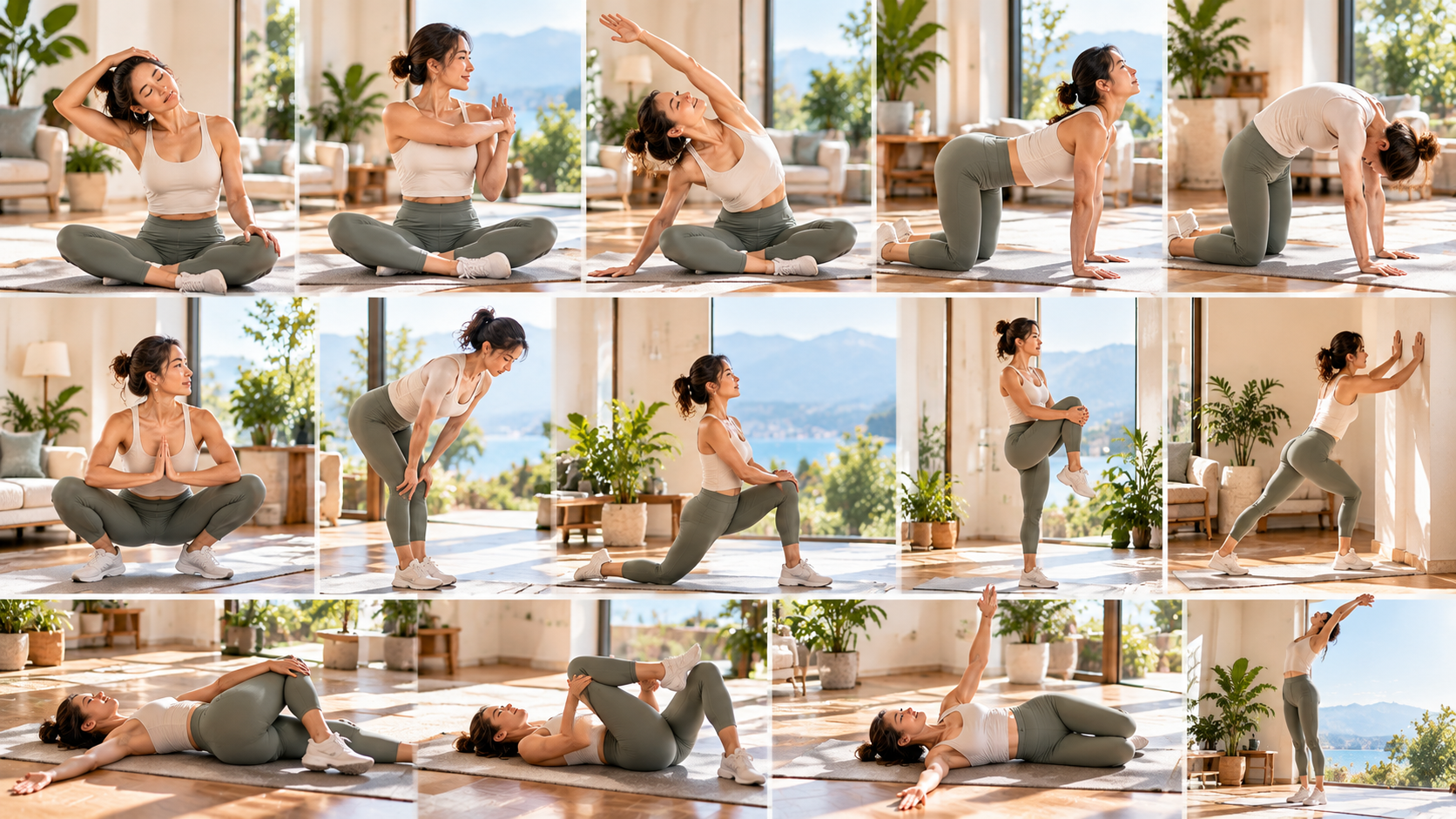
The Complete 10-Minute Routine
For easy reference:
Minute 1: Neck and shoulders
Minute 2: Upper-back rotation
Minute 3: Reach and side bend
Minute 4: Hip circles
Minute 5: Hip hinge
Minute 6: Supported squat
Minute 7: Alternating lunge reach
Minute 8: Ankle rock
Minute 9: Heel-to-toe movement
Minute 10: Full-body flow
You do not have to watch the clock obsessively.
If one area needs a little more attention, spend longer there.
If another movement does not work well for you, shorten it or replace it.
The routine is a framework.
Should You Do Mobility Every Day?
A gentle mobility routine can be practical to perform regularly if the movements are comfortable and appropriate for you.
But you do not need to believe that missing one day will cause your mobility to disappear.
Frequency should match the intensity of the activity and your individual needs.
A light movement routine is very different from aggressively stretching a joint to its maximum range.
For most people, the objective should be regular exposure to comfortable movement rather than repeatedly forcing extreme positions.
Is Morning or Evening Better?
There is no universal best time.
Morning mobility may feel useful after spending several hours in bed.
A midday routine may help break up prolonged sitting.
An evening routine may simply fit your schedule better.
Consistency matters more than finding a theoretically perfect hour.
One caution: your body may feel relatively stiff immediately after waking.
That is another reason to begin gently rather than trying to reach your maximum range during the first movement of the day.
Should You Stretch Before This Routine?
Usually, you do not need a separate stretching session before a gentle mobility routine.
Start with small, easy movements and gradually explore a little more range as you warm up.
For more demanding exercise, warm-up needs may differ depending on the activity.
NIA recommends stretching when muscles are warmed up and after endurance or strength exercise.
The important principle is not to force cold muscles and joints immediately into aggressive end-range positions.
Mobility Does Not Replace Strength
This deserves special attention.
Being able to reach a position is useful.
Being able to control and produce force in useful positions is also important.
That is why strength training and mobility training work well together.
Squats, lunges, rows, presses, step-ups, and other strength exercises can challenge your ability to control joints while producing force.
CDC recommends that adults perform muscle-strengthening activities involving all major muscle groups on at least two days each week.
So do not think of mobility as an alternative to strength training.
Think of them as complementary pieces.
Mobility Does Not Replace Cardio Either
Stretching and gentle mobility movements are useful, but they generally do not provide the same cardiovascular stimulus as brisk walking, cycling, swimming, or other moderate-to-vigorous aerobic activities.
The current U.S. guideline for adults remains at least 150 minutes of moderate-intensity aerobic activity per week, or 75 minutes of vigorous activity, or an equivalent combination, plus muscle-strengthening activity on at least two days per week.
The Physical Activity Guidelines specifically note that time spent doing flexibility activities alone does not count toward the aerobic or muscle-strengthening recommendations.
Your 10-minute mobility routine is an addition to an active lifestyle—not a replacement for the rest of it.
What If One Side Is Tighter Than the Other?
Small differences between sides are common.
You may notice that one hip rotates more easily.
One ankle moves farther.
One shoulder reaches overhead more comfortably.
You do not necessarily need to “fix” every small asymmetry.
Instead, pay attention to whether the difference is substantial, worsening, painful, or interfering with normal activity.
Avoid aggressively forcing the tighter side to match the other.
Gradual, controlled practice is generally more sensible than turning mobility into a battle against your body.
Stretching Sensation vs. Pain
A mild stretching sensation can be normal.
Pain is different.
NIA specifically recommends not stretching so far that it hurts.
Stop or modify an exercise if you experience sharp pain, sudden pain, significant joint discomfort, dizziness, or instability that makes the movement unsafe.
Persistent or unexplained limitations deserve more individualized attention.
A physical therapist or other qualified healthcare professional can help determine whether a particular restriction needs targeted treatment rather than a generic mobility routine.
You Don’t Need to Become Extremely Flexible
More flexibility is not always the goal.
Daily life requires enough range of motion to perform the activities that matter to you.
That might mean:
Reaching overhead comfortably.
Getting down toward the floor.
Turning to look behind you.
Walking with a comfortable stride.
Climbing stairs.
Getting in and out of a chair.
Exercising with controlled technique.
Your useful mobility needs depend partly on what you want and need to do.
A gymnast and an office worker do not require identical ranges of motion.
Mobility training should support your life.
How to Progress the Routine
Do not immediately add harder stretches.
Progress can be subtle.
You might gradually:
Move with better control.
Use a slightly larger comfortable range.
Perform a movement more smoothly.
Need less support during a balance drill.
Coordinate several joints more easily.
Or notice that everyday movements feel less restricted.
Those are meaningful improvements.
Mobility progress is not measured only by how close you can get to the floor.
Make the Routine Easy to Repeat
The best mobility routine is not necessarily the most sophisticated one.
It is one you actually perform.
Attach it to something already in your day.
After your morning coffee.
Before your daily walk.
After shutting down your computer.
Before a strength workout.
While waiting for dinner to cook.
Keeping the routine simple reduces the number of decisions required to start.
And once you know the movements, you may not need a timer or video at all.
The Daily Bearings Takeaway
A useful daily mobility routine does not need to be long, painful, or complicated.
Ten minutes is enough time to move several major areas of your body through comfortable, controlled ranges.
Start gently.
Move your neck and shoulders.
Rotate your upper back.
Explore movement through your hips.
Practice a hip hinge and squat.
Move your ankles.
Include a small amount of controlled balance work.
And finish by connecting several movements together.
Remember that mobility is only one part of physical fitness.
Regular aerobic activity, strength training, balance work, and appropriate recovery still matter.
Most importantly, do not chase extreme range.
Build movement you can comfortably control and actually use.
Move. Breathe. Nourish.
This article is for general educational purposes and is not a substitute for individualized medical advice. If you have a medical condition, disability, or concerns about beginning a new exercise or nutrition routine, consider discussing appropriate changes with a qualified healthcare professional.
References
National Institute on Aging — Three Types of Exercise Can Improve Your Health and Physical Ability
Official NIA guidance covering flexibility, strength and balance exercises, including safety considerations.
Centers for Disease Control and Prevention — Adult Activity: An Overview
Current CDC recommendations for adult aerobic and muscle-strengthening activity.
Physical Activity Guidelines for Americans, 2nd Edition
U.S. evidence-based guidance covering flexibility activities and their role alongside aerobic and muscle-strengthening exercise.