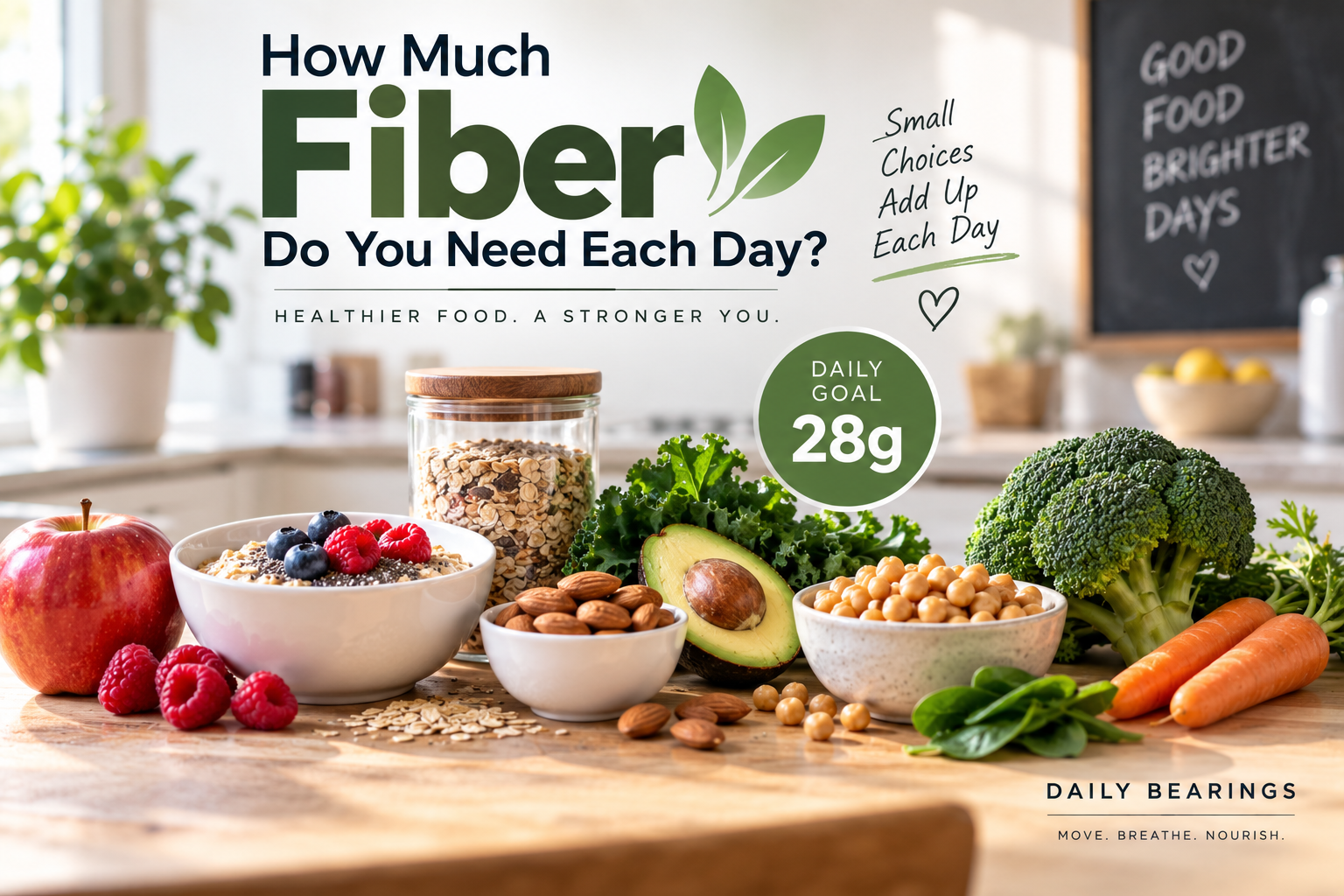
How Much Fiber Do You Need Each Day?
Fiber may not get as much attention as protein, but it plays an important role in a healthy eating pattern.
It is found naturally in plant foods such as vegetables, fruits, beans, lentils, whole grains, nuts, and seeds. Unlike many other carbohydrates, dietary fiber is not fully broken down and absorbed in the small intestine.
But knowing that fiber is “good for you” leaves an important practical question:
How much fiber do you actually need each day?
The answer depends somewhat on age, sex, and overall energy intake. Still, there are useful targets that can help you judge whether your everyday diet is providing enough.
And for most people, reaching those targets does not require fiber supplements or an unusually restrictive diet.
It starts with choosing a wider variety of fiber-rich foods.
What Is Dietary Fiber?
Dietary fiber is a type of carbohydrate found mainly in plant foods.
The body does not digest fiber in exactly the same way it digests sugars and starches. Instead, different types of fiber travel through the digestive system and can have different physical and physiological effects.
According to the U.S. Food and Drug Administration, the Daily Value for dietary fiber used on Nutrition Facts labels is 28 grams per day, based on a 2,000-calorie diet.
That does not mean 28 grams is the perfect number for every individual.
It is a useful reference point.
Your actual needs can vary depending on factors such as age, sex, energy needs, and medical circumstances.
How Much Fiber Do Adults Need?
There is no single fiber number that applies perfectly to every adult.
The National Institute of Diabetes and Digestive and Kidney Diseases notes that adults generally need about 22 to 34 grams of fiber each day, depending on age and sex.
Meanwhile, the FDA’s Daily Value of 28 grams gives shoppers a convenient benchmark when reading food labels.
These numbers are better viewed as practical guides than as a daily pass-or-fail test.
If you eat 25 grams one day and 30 grams the next, there is usually no reason to obsess over the difference.
Your overall eating pattern matters more.
Why Is Fiber Important?
Fiber does more than simply add bulk to food.
Different types of dietary fiber can contribute to health in different ways.
Fiber can help support normal bowel function and can make stools easier to pass. Certain fibers can also help increase feelings of fullness, while some soluble fibers may contribute to healthy blood cholesterol levels.
Fiber-rich foods also tend to bring other nutrients with them.
A bowl of oatmeal provides more than fiber.
Beans provide fiber along with plant protein and minerals.
Fruit provides fiber along with vitamins and a variety of plant compounds.
Vegetables, nuts, seeds, and whole grains each contribute their own nutritional package.
This is one reason it is usually more useful to think about fiber-rich foods rather than fiber as an isolated number.
Soluble vs. Insoluble Fiber
You may have heard fiber divided into two categories:
soluble fiber and insoluble fiber.
Soluble fiber can dissolve in water and form a gel-like material. Foods containing soluble fiber include oats, beans, peas, apples, citrus fruits, and some seeds.
Insoluble fiber does not dissolve in water in the same way and can help add bulk to stool. It is found in foods such as wheat bran, many vegetables, and whole grains.
But this distinction should not make eating unnecessarily complicated.
Many plant foods contain mixtures of different fibers.
You do not need to calculate separate daily targets for soluble and insoluble fiber in order to build a healthy diet.
Eating a variety of vegetables, fruits, legumes, whole grains, nuts, and seeds naturally provides different types of fiber.
Are You Getting Enough Fiber?
You do not necessarily need to count every gram.
Instead, look at the structure of your meals.
Do vegetables appear regularly?
Do you eat whole fruit rather than relying mainly on juice?
Do beans or lentils appear in your diet?
Are at least some of your grain choices whole grains?
Do you eat nuts or seeds?
If most meals are built around highly refined grains, processed foods, and very few plant foods, fiber intake may be relatively low.
Our guide How to Build a Healthy, Balanced Meal explains a simple way to combine vegetables, whole grains, protein foods, and healthy fats without turning every meal into a nutrition calculation.
Fiber fits naturally into that approach.
How Much Fiber Is Actually in Food?
Fiber targets become much easier to understand when translated into real food.
Amounts vary by product and serving size, but common fiber-rich foods can contribute meaningful amounts throughout the day.
For example, foods such as:
- lentils
- black beans
- chickpeas
- raspberries
- pears
- apples
- oats
- whole-grain cereals
- broccoli
- Brussels sprouts
- chia seeds
- almonds
can all contribute toward your daily intake.
The important point is that you do not need one enormous serving of fiber.
You can accumulate it across meals.
Oatmeal and fruit at breakfast, beans at lunch, vegetables with dinner, and nuts or fruit as a snack can collectively make a substantial difference.
A Simple High-Fiber Day
Imagine a normal day of eating.
Breakfast might include oatmeal topped with berries and a small amount of nuts or seeds.
Lunch could include a whole-grain wrap or bowl containing vegetables, beans, and a protein source.
An afternoon snack might be an apple or pear with a handful of nuts.
Dinner could include vegetables, a whole grain such as brown rice or barley, and another protein-rich food.
No single meal needs to contain an extreme amount of fiber.
The total builds gradually throughout the day.
This approach also has another advantage:
It encourages dietary variety.
Instead of relying on one “superfood,” you get fiber from several different plant sources.
Beans and Lentils Are Especially Useful
Legumes deserve special attention because they can contribute both fiber and protein.
Beans, chickpeas, peas, and lentils can be added to soups, salads, bowls, stews, and many other meals.
They can also complement animal protein rather than necessarily replacing it.
For example, you might add beans to a chicken salad or lentils to a soup that contains another protein source.
This can help increase fiber while also contributing to overall protein intake.
If you are unsure how much protein you need, see How Much Protein Do You Need Each Day?.
Thinking about fiber and protein together can make meals both practical and satisfying.
Whole Fruit vs. Fruit Juice
Whole fruit is generally a better fiber source than juice.
When fruit is processed into juice, much of the original fiber may be removed.
That does not mean fruit juice must never be consumed.
It simply means juice should not automatically be considered nutritionally identical to eating the whole fruit.
An orange, apple, pear, or bowl of berries contributes fiber along with water and other nutrients.
If increasing fiber is one of your goals, choosing whole fruit more often is an easy place to start.
Whole Grains Can Make a Difference
Another simple strategy is replacing some refined grains with whole grains.
Examples might include:
brown rice instead of white rice,
whole-grain bread instead of refined white bread,
oatmeal instead of a low-fiber breakfast option,
or whole-grain pasta in place of refined pasta.
You do not have to replace every refined grain immediately.
Even changing one regular food can increase fiber intake over time.
Nutrition does not need to be all-or-nothing.
Read the Nutrition Facts Label
Packaged foods can vary enormously in fiber content.
Two breads that look similar may contain very different amounts.
The same can be true for cereal, wraps, snack bars, and other products.
This is where the Nutrition Facts label becomes useful.
Look for Dietary Fiber under Total Carbohydrate.
The FDA uses 28 grams per day as the Daily Value, so the percentage shown on the label indicates how much a serving contributes toward that reference amount.
The FDA’s guidance on Daily Values and Nutrition Facts labels can help you understand these percentages.
But remember to check the serving size too.
A product may appear high in fiber until you realize the listed serving is larger than the amount you normally eat—or the reverse.
Is More Fiber Always Better?
Not necessarily.
This is an important point.
Nutrition advice sometimes becomes simplified into:
“If some is good, more must be better.”
Fiber does not work that way.
Research supported by the National Institutes of Health has highlighted that different fibers can produce different biological effects and that individual responses can vary.
There is little reason for most people to chase extremely high fiber numbers simply because they exceed a guideline.
The goal is not to consume as much fiber as physically possible.
The goal is to build a balanced eating pattern that provides enough.
Increase Fiber Gradually
If your current diet contains relatively little fiber, suddenly doubling your intake may not feel comfortable.
A rapid increase can contribute to:
- gas
- bloating
- abdominal discomfort
- changes in bowel habits
The NIDDK recommends adding fiber to the diet a little at a time so the body can adjust.
That is especially relevant if your normal eating pattern currently contains very few vegetables, whole grains, legumes, fruits, nuts, or seeds.
You do not need to transform your entire diet overnight.
Add one change.
Then another.
For example, start by adding fruit to breakfast.
Later, switch one grain to a whole-grain option.
Then add beans to one or two meals during the week.
Small changes can accumulate just as fiber itself does.
Don’t Forget Fluids
Fiber and fluid intake are closely connected, particularly when the goal is supporting comfortable bowel function.
The NIDDK advises drinking water and other liquids when increasing fiber intake because fluids can help fiber work more effectively and make stools softer and easier to pass.
There is no need to force enormous amounts of water simply because you ate fiber.
But consistently eating more fiber while ignoring hydration may not be comfortable for everyone.
Let fiber and adequate fluid intake increase together.
Food First or Fiber Supplements?
For most healthy eating patterns, food is a useful starting point.
Whole foods provide more than isolated fiber.
Vegetables, fruits, legumes, whole grains, nuts, and seeds also provide vitamins, minerals, protein, healthy fats, and other compounds.
Fiber supplements can have legitimate uses, and healthcare professionals may recommend them in certain situations.
But a supplement does not automatically provide all the nutritional benefits of the foods that naturally contain fiber.
If you can increase fiber through food, that approach can improve the overall quality and variety of your diet at the same time.
What About Low-Carbohydrate Diets?
People following a lower-carbohydrate eating pattern can still consume fiber.
Fiber-rich foods are not limited to bread, pasta, and grains.
Non-starchy vegetables, avocados, nuts, seeds, and certain fruits can provide fiber while fitting into many lower-carbohydrate approaches.
Beans and legumes may also fit depending on the specific diet.
The key is avoiding the assumption that reducing refined carbohydrates means eliminating fiber-rich plant foods altogether.
Your overall dietary pattern matters.
Does Cooking Destroy Fiber?
Cooking can change the texture and structure of foods, but cooked vegetables can still be valuable sources of fiber.
You do not need to eat every vegetable raw to get fiber.
Roasted vegetables, steamed broccoli, cooked beans, soups, stews, and other cooked plant foods can all contribute.
This matters because the best eating pattern is one you can actually maintain.
If you enjoy cooked vegetables more than raw vegetables, eating cooked vegetables consistently is generally more useful than forcing yourself to eat salads you dislike.
Fiber Needs Can Change With Age
Fiber remains important throughout adulthood, but recommended intake can vary with age and sex.
Energy intake often changes over time, which is one reason fiber recommendations are not identical for every person.
Older adults may also experience changes in appetite, food intake, physical activity, medications, or digestive function that affect eating habits.
The goal should remain practical:
Include fiber-rich plant foods regularly and adjust according to individual needs and tolerance.
If you have persistent digestive symptoms or a medical condition affecting your gastrointestinal system, generalized fiber advice may not be appropriate for your situation.
Some Medical Conditions Require Individual Guidance
Fiber is beneficial for many people, but there are situations in which a healthcare professional may recommend temporarily or chronically modifying fiber intake.
Certain gastrointestinal conditions, procedures, surgeries, or episodes of digestive illness can change what is appropriate.
This is why statements such as “everyone should simply eat more fiber” are too broad.
Population-level nutrition recommendations are useful starting points.
They are not individualized medical prescriptions.
If increasing fiber consistently causes significant pain or digestive symptoms, simply continuing to increase the amount may not be the right response.
You Don’t Need to Track Fiber Forever
Tracking can be educational for a short period.
If you have no idea how much fiber you normally consume, looking at labels or recording a few typical days can show where your diet stands.
But long-term healthy eating does not necessarily require counting every gram.
You can instead build habits that naturally produce a fiber-rich diet:
Eat vegetables regularly.
Choose whole fruit.
Include beans or lentils.
Use whole grains when practical.
Eat nuts and seeds.
Vary your plant foods.
Once these patterns become routine, the numbers become less important.
Fiber Is Part of the Bigger Nutrition Picture
Fiber is valuable, but it is only one part of nutrition.
A food is not automatically healthy simply because it contains fiber.
Your body also needs adequate protein, essential fats, vitamins, minerals, and sufficient energy.
That is why a balanced meal is more useful than optimizing one nutrient in isolation.
A meal containing vegetables, a quality protein source, a fiber-rich carbohydrate, and healthy fats can address several nutritional needs simultaneously.
This is also why Daily Bearings focuses on practical eating patterns rather than chasing individual nutrients as if they work independently.
The Daily Bearings Takeaway
So, how much fiber do you need each day?
For adults, a useful general range is roughly 22 to 34 grams per day, depending on age and sex, while the FDA uses 28 grams per day as the Daily Value on Nutrition Facts labels.
But you do not need to hit an identical number every day.
Instead, focus on the foods that naturally provide fiber.
Eat more vegetables and whole fruit.
Include beans and lentils.
Choose whole grains when practical.
Add nuts and seeds.
Increase fiber gradually if your current intake is low, and remember that adequate fluids matter too.
Most importantly, do not treat fiber as another number you have to perfect.
Use it as one indicator of a varied, plant-rich, balanced way of eating.
Move. Breathe. Nourish.
This article is for general educational purposes and is not a substitute for individualized medical advice. If you have a medical condition, disability, or concerns about beginning a new exercise or nutrition routine, consider discussing appropriate changes with a qualified healthcare professional.
References
U.S. Food & Drug Administration — Daily Value on the Nutrition and Supplement Facts Labels
Official FDA information on Daily Values, including the 28-gram Daily Value for dietary fiber.
National Institute of Diabetes and Digestive and Kidney Diseases — Eating, Diet, & Nutrition
Guidance on adult fiber intake, fiber-rich foods, gradually increasing fiber, and fluid intake.
National Institutes of Health — Health Benefits of Dietary Fibers Vary
NIH research summary explaining how different types of dietary fiber may produce different physiological effects.