How Many Reps and Sets Should You Do for Strength Training?
Starting strength training often creates more questions than expected.
How many repetitions should you do?
Is one set enough?
Do you need three sets of every exercise?
Should you lift a heavier weight for fewer repetitions—or a lighter weight for more?
These details can make a simple workout feel unnecessarily complicated.
Fortunately, you do not need a perfect mathematical formula to begin building strength.
For general health and everyday function, the basic principles are surprisingly straightforward: work the major muscle groups, use enough resistance to challenge them, allow recovery, and gradually make the exercise more demanding as you become stronger.
Understanding repetitions and sets simply gives you a practical way to organize that work.
What Are Reps and Sets?
A repetition, usually shortened to rep, is one complete performance of an exercise.
If you lower yourself into a squat and stand back up, that is one repetition.
If you press a dumbbell overhead and return it to the starting position, that is one repetition.
A set is a group of repetitions performed before you rest.
For example:
10 squats → rest → 10 squats → rest → 10 squats
That would be:
10 repetitions × 3 sets
Once you understand this distinction, most strength-training programs become much easier to read.
How Many Reps Should You Do?
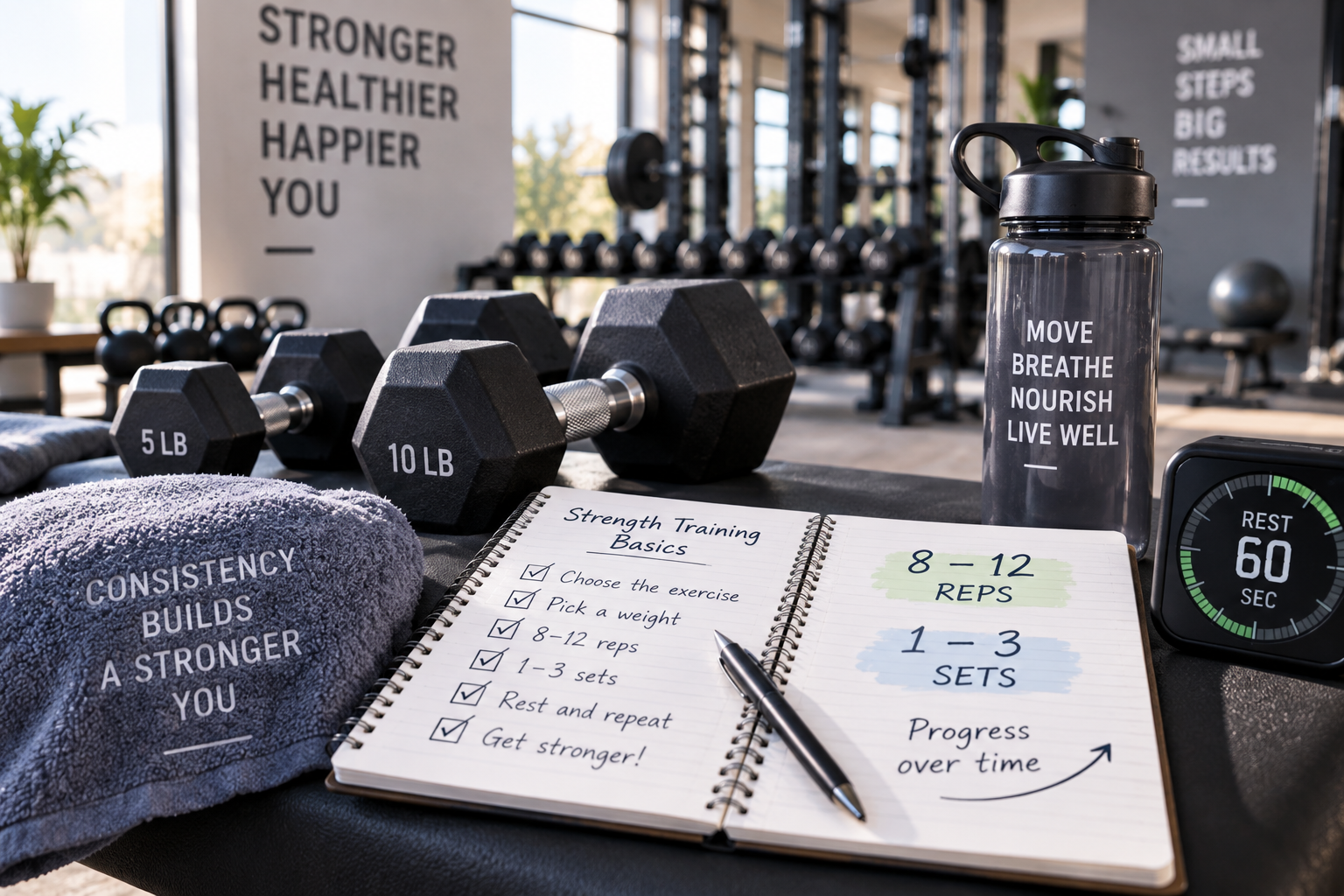
For general muscle-strengthening activity, 8 to 12 repetitions per exercise is a useful evidence-based range.
CDC recommends performing muscle-strengthening exercises to the point where completing another repetition without assistance becomes difficult. It describes 8–12 repetitions as one set.
This does not mean the number 8 suddenly makes an exercise effective or that repetition 13 becomes useless.
The underlying principle is more important:
The resistance should eventually challenge the muscle.
Imagine performing 10 dumbbell curls.
If repetition 10 feels almost as easy as repetition 1 and you could comfortably perform another 20, the resistance may not be particularly challenging for you.
On the other hand, if your technique begins falling apart after repetition 4, the resistance may be too difficult for the intended workout.
For many adults training for general health, a resistance that makes the later repetitions challenging while still allowing controlled technique is a practical starting point.
Is One Set Enough?
This is where beginners often make strength training more complicated than necessary.
You do not necessarily need three, four, or five sets of every exercise.
CDC states that at least one set of muscle-strengthening activity is recommended and that two or three sets may provide additional benefits.
The Physical Activity Guidelines evidence review similarly concluded that one set of 8–12 repetitions can effectively increase muscular strength, while limited evidence suggests two or three sets may be more effective.
That makes one set particularly useful for beginners.
A short workout that you actually perform consistently can be much more valuable than an elaborate program that feels too demanding to maintain.
As your experience grows, adding another set is one way to increase your training.
Beginners Do Not Need a Bodybuilding Routine
Strength training for health is not the same thing as training for competitive bodybuilding or powerlifting.
Your goal may simply be to:
carry groceries more comfortably,
climb stairs,
lift luggage,
maintain muscle,
get up from the floor,
continue doing household tasks,
or remain physically capable as you age.
For those goals, you do not need dozens of exercises or a highly specialized split routine.
The Physical Activity Guidelines recommend muscle-strengthening activities involving the major muscle groups on at least two days each week. These include the legs, hips, back, abdomen, chest, shoulders, and arms.
If you are wondering how those days should fit into your week, read How Many Days a Week Should You Strength Train?
That article focuses on training frequency.
This one focuses on what happens inside each workout.
How Heavy Should the Weight Be?
There is no single correct dumbbell weight for everyone.
A 10-pound dumbbell could be challenging for one person and extremely easy for another.
Even within the same person, different exercises require different resistance.
You might use considerably more resistance for a squat than for a lateral shoulder raise.
Instead of choosing weight according to someone else’s numbers, ask:
How difficult are the final repetitions for me?
CDC’s practical standard is useful here: muscle-strengthening activity should reach a point where performing another repetition without help becomes difficult.
That does not mean every set must become an all-out struggle.
Especially for beginners, good technique and gradual progression matter more than proving how much weight you can lift.
Technique Comes Before the Rep Target
Suppose your goal is 10 repetitions.
You reach repetition 8 and your technique starts deteriorating.
Should you force repetitions 9 and 10 simply because they are written in your plan?
Usually, the better approach is to treat the repetition target as a guide rather than permission to ignore technique.
Poor technique may shift the load away from the muscles you intended to train and may expose you to unnecessary stress.
This is particularly important when learning unfamiliar movements.
Start with resistance that allows you to understand the movement.
Then build from there.
NIA specifically notes that beginners can start strength exercises without weights or resistance bands until they are comfortable with the movements.
What If 8–12 Reps Feels Too Difficult?
Adjust the exercise.
You can reduce the weight.
Use a lighter resistance band.
Choose an easier variation.
Reduce the range of motion when appropriate.
Or perform fewer repetitions while you learn the movement.
Someone starting with chair squats, for example, may not initially need to chase 12 repetitions.
The goal is to establish safe, repeatable movement and gradually develop capacity.
The 8–12 range is useful guidance—not a test you must pass on your first workout.
What If 12 Reps Becomes Easy?
That is usually a sign that your body has adapted.
Strength improves when muscles are asked to do more work than they are accustomed to doing. The Physical Activity Guidelines describe muscle strengthening in terms of overloading the muscles.
If an exercise that once challenged you becomes consistently easy, you can gradually increase the challenge.
You might:
increase the resistance,
perform another set,
use a more challenging exercise variation,
increase the range of motion,
or improve the control and quality of the movement.
You do not need to change everything at once.
Small increases are enough.
Progress Does Not Mean Adding Weight Every Workout
This deserves emphasis.
Progressive strength training does not mean you must constantly place heavier dumbbells in your hands.
Progress can take many forms.
Perhaps you originally needed your hands to stand from a chair and now you can stand without them.
Perhaps you can perform a controlled squat through a greater range of motion.
Perhaps you moved from one set to two.
Perhaps you can carry groceries farther without fatigue.
Perhaps the same exercise simply feels more stable.
NIA notes that gradually increasing weight, sets, repetitions, or training frequency can contribute to stronger muscles.
Progress is broader than the number printed on a dumbbell.
Should You Do the Same Number of Reps for Every Exercise?
Not necessarily.
Different movements and equipment can make different repetition ranges practical.
Bodyweight exercises are a good example.
You may be able to perform many bodyweight squats but only a few push-ups.
That does not mean one exercise is working and the other is failing.
The resistance relative to your strength is different.
For general health, you do not need to make every exercise fit perfectly into an identical repetition scheme.
What matters is that the exercise provides an appropriate challenge and that you can perform it with good control.
How Long Should You Rest Between Sets?
There is no universal rest period required for every general fitness workout.
Your rest depends on the exercise, resistance, fitness level, and training goal.
For a beginner performing moderate resistance exercises, resting long enough to regain control of breathing and perform the next set with good technique is reasonable.
Do not rush simply because a timer tells you to start.
A demanding squat set may require more recovery than a light arm exercise.
If you are still breathing heavily or feel that fatigue will noticeably compromise your next set, additional rest may be appropriate.
Don’t Confuse Muscle Fatigue With Pain
Strength training should challenge your muscles.
You may experience temporary fatigue, effort, or a burning sensation in the working muscles.
But sharp, sudden, or unusual pain is different.
Pain is not proof that an exercise is effective.
If a particular movement repeatedly causes pain, forcing more repetitions is not a sensible progression strategy.
Adjusting the exercise, resistance, or range of motion may help.
Persistent or concerning symptoms may warrant guidance from a qualified healthcare or exercise professional.
How Many Exercises Do You Need?
You do not need an exercise for every muscle you can name.
Instead, think in terms of major movement patterns and muscle groups.
A simple full-body workout might include:
Squat or sit-to-stand
Legs and hips
Hip hinge
Hips and posterior chain
Push
Chest, shoulders, and arms
Pull
Back and arms
Carry or core exercise
Trunk and whole-body stability
That can provide a much simpler structure than selecting exercises randomly.
The federal guidelines emphasize working all major muscle groups, rather than prescribing a specific list of gym exercises.
A Simple Beginner Strength Workout
Here is one example for someone who is comfortable performing these movements.
Chair squat or bodyweight squat
8–12 repetitions
Wall, counter, or floor push-up
8–12 repetitions, adjusted to ability
Resistance-band or dumbbell row
8–12 repetitions
Hip hinge or light Romanian deadlift
8–12 repetitions
Dumbbell overhead press
8–12 repetitions
Start with one set of each exercise.
If that becomes comfortable and you want more training, gradually work toward two sets.
Later, three sets may be appropriate depending on your goals, recovery, and available time.
You do not need to reach that point immediately.
If you need more help getting started without a gym, see How to Start Strength Training at Home.
Recovery Is Part of Strength Training
Muscles do not become stronger simply because you perform more and more sets without rest.
Training provides the stimulus.
Recovery allows adaptation.
NIA advises avoiding strength training the same muscle group on two consecutive days to allow recovery between sessions.
This is another reason beginners do not need enormous training volumes.
More work is not automatically better.
The appropriate amount is enough to challenge your body while still allowing you to recover and repeat the training consistently.
Strength Training Becomes More Important With Age
Muscle strength supports much more than appearance.
NIA notes that muscle-strengthening activity can improve physical function and make everyday tasks such as getting up from a chair, climbing stairs, and carrying groceries easier. It can also support maintenance of strength and muscle mass as people age.
That connects strength training directly with independence.
Our guide How to Stay Independent as You Age explains how strength, mobility, balance, and everyday movement work together to preserve physical function.
You do not need to wait until daily tasks become difficult before paying attention to strength.
Building and maintaining it earlier can become part of long-term healthy aging.
Avoid Chasing Perfect Numbers
It is easy to become obsessed with programming.
Should you perform 8 reps or 10?
Two sets or three?
Should you rest 60 seconds or 90?
Those details can matter when someone is training toward a specific athletic goal.
But for many adults, a much larger issue is simply performing muscle-strengthening activity consistently.
CDC recommends adults perform muscle-strengthening activity on at least two days each week.
If you currently perform none, establishing two manageable weekly sessions matters more than finding a theoretically perfect repetition scheme.
Build the habit first.
Refine the details as you gain experience.
The Daily Bearings Takeaway
So, how many reps and sets should you do?
For general strength training, 8–12 repetitions per exercise is a practical starting range.
One challenging set can be effective.
Two or three sets may provide additional benefit as you become more experienced and want to do more.
But the numbers are not the entire workout.
The resistance should challenge you.
Your technique should remain controlled.
The major muscle groups should receive attention.
And the training should progress gradually as your body adapts.
You do not need a complicated program to become stronger.
Start with a manageable amount.
Practice the movements.
Recover.
Then gradually ask your body to do a little more.
Move. Breathe. Nourish.
This article is for general educational purposes and is not a substitute for individualized medical advice. If you have a medical condition, disability, or concerns about beginning a new exercise or nutrition routine, consider discussing appropriate changes with a qualified healthcare professional.
References
Centers for Disease Control and Prevention — What Counts as Physical Activity for Adults
Practical CDC guidance on muscle-strengthening activity, repetitions, sets, and major muscle groups.
CDC — What Counts as Physical Activity for Adults
Centers for Disease Control and Prevention — Adult Activity: An Overview
Current recommendations for aerobic and muscle-strengthening activity in adults.
CDC — Adult Activity Guidelines
National Institute on Aging — Three Types of Exercise Can Improve Your Health and Physical Ability
Guidance on strength exercise, progression, recovery, and physical function.
NIA — Strength and Other Types of Exercise