How Heavy Should You Lift for Strength Training?
Choosing the right weight is one of the most confusing parts of strength training.
Pick a weight that is too light, and you may finish every set feeling as though you could keep going for a long time.
Pick one that is too heavy, and your technique may begin to break down before you complete useful repetitions.
So how heavy should you actually lift?
There is no single number that works for everyone.
The right resistance depends on the exercise, your current strength, experience, physical abilities, and how many repetitions you are trying to perform.
For general strength and health, a useful principle is surprisingly simple:
Choose enough resistance that the final repetitions feel challenging while you can still perform the exercise with controlled technique.
You do not need to test the heaviest weight you can possibly lift.
And you certainly do not need to compare your dumbbells with someone else’s.
The goal is to find a resistance that challenges your muscles appropriately.
There Is No Universal “Correct” Weight
A common beginner question is:
“Should I start with 5-pound dumbbells?”
Or:
“Is 20 pounds enough?”
Those numbers have very little meaning without context.
A weight that feels easy during a squat may feel extremely difficult during a lateral shoulder raise.
Likewise, two people of the same age and body size may have very different strength levels.
This is why choosing resistance based only on age, sex, or body weight is rarely useful.
Instead of asking:
“What weight should everyone lift?”
A better question is:
“How challenging is this weight for this exercise and repetition range?”
That shift makes strength training much easier to personalize.
What Do Official Guidelines Recommend?
CDC guidance recommends muscle-strengthening activity involving all major muscle groups on at least two days each week.
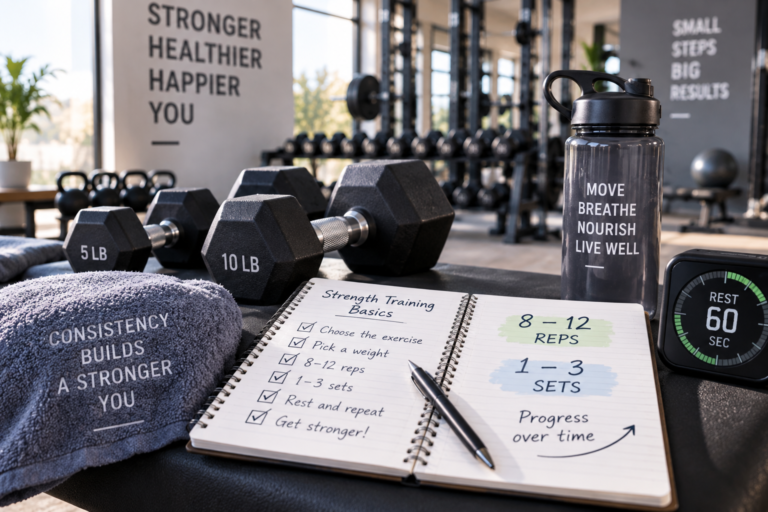
For an individual exercise, the CDC suggests trying 8–12 repetitions, with at least one set. Two or three sets may provide additional benefits.
Most importantly for choosing resistance, the activity should be challenging enough that completing another repetition without assistance would be difficult.
That gives us a much more useful standard than an arbitrary dumbbell weight.
The resistance should eventually become challenging.
But challenging does not mean uncontrolled.
What Should the Last Few Reps Feel Like?
Imagine you plan to perform 10 repetitions of an exercise.
The first few repetitions may feel fairly comfortable.
As the set continues, your muscles should have to work progressively harder.
By repetitions eight, nine, and ten, the exercise should require meaningful effort.
Your movement should still look controlled.
But you should not finish the tenth repetition thinking:
“I could easily do another 15.”
If you consistently feel that way, the resistance may be too light for the training goal.
On the other hand, if your posture changes dramatically by repetition four, you cannot control the weight, or you need momentum just to finish the movement, the resistance may be too heavy.
The useful zone lies between those extremes.
Challenging Does Not Mean Maximum
This distinction is important.
Strength training does not require lifting the heaviest weight you can possibly move.
A maximum-effort single repetition is very different from a normal set performed for general health and strength.
Most adults training for everyday strength do not need to regularly test their one-repetition maximum.
Instead, you can judge resistance through the quality and difficulty of your normal working sets.
For many people, that is simpler, safer, and much more practical.
Beginners Should Start Conservatively
If you are new to strength training, your first priority is not finding the perfect weight.
It is learning the movement.
The National Institute on Aging advises beginners that they can initially perform exercises without weights or resistance bands until they are comfortable with the movements.
That is especially useful for exercises such as:
Squats.
Lunges.
Rows.
Presses.
Hip hinges.
Learning how the movement should feel gives you a foundation for adding resistance later.
Our How to Start Strength Training at Home guide explains how to build a simple beginner routine without turning your first workouts into complicated gym programs.
A Simple Way to Choose Your Starting Weight
You do not need an equation.
Choose a relatively light resistance and perform the exercise with controlled technique.
Suppose your target is somewhere around 8–12 repetitions.
Pay attention to what happens.
If you reach 12 repetitions and feel that you could easily continue for many more, you can consider slightly more resistance next time.
If you cannot approach the intended range without your technique breaking down, reduce the resistance.
If the later repetitions are difficult but still controlled, you are probably much closer to an appropriate working weight.
This method naturally adjusts for individual differences.
Technique Comes Before the Number on the Dumbbell
There is little value in lifting a heavier dumbbell if doing so completely changes the exercise.
Consider a dumbbell curl.
With an appropriate resistance, your elbow position remains relatively stable and your arm performs the movement.
With excessive resistance, you might begin swinging your torso and using momentum to throw the dumbbell upward.
The scale says you lifted more weight.
But you also changed how the movement was performed.
This is why progression should never be judged by weight alone.
Good strength training involves both effort and control.
How Do You Know If a Weight Is Too Light?
A resistance may be too light if:
You finish your planned repetitions with very little effort.
The final repetitions feel almost identical to the first few.
You could perform many additional repetitions without much difficulty.
You have used the same resistance for a long time even though the exercise has become substantially easier.
That does not mean light weights are useless.
Light resistance can be appropriate when learning technique, warming up, returning after a break, working around physical limitations, or performing exercises where relatively small loads are challenging.
The issue is not whether the number printed on the weight looks small.
The issue is whether the exercise provides an appropriate challenge.
How Do You Know If a Weight Is Too Heavy?
Possible signs include:
You cannot control the movement.
You dramatically shorten the range of motion just to finish repetitions.
You rely heavily on momentum.
Your technique changes immediately.
You cannot perform the intended repetitions despite being reasonably familiar with the exercise.
Or you experience pain rather than ordinary muscular effort.
A difficult set and a painful set are not the same thing.
Muscular fatigue and effort are expected during strength training.
Sharp, sudden, or concerning pain is not something you should simply push through.
You Don’t Need to Train to Complete Failure
You may hear gym advice saying every set must continue until you physically cannot complete another repetition.
That is not necessary for the general health approach we are discussing.
Official guidance describes muscle-strengthening activity as being performed to the point where another repetition would be difficult.
There is a meaningful difference between:
“Another repetition would be difficult.”
and
“I must keep going until I physically fail.”
For general fitness, you can train hard without turning every set into an all-out test.
The Right Weight Changes With the Exercise
Do not expect to use the same dumbbell for everything.
Large muscle groups and multi-joint movements often tolerate more resistance than exercises involving smaller muscles.
For example, you may eventually use substantially more resistance for a squat or deadlift variation than for a shoulder raise.
Even exercises that look similar can require different loads.
That is normal.
Your goal is not to create one universal “training weight.”
Choose resistance for each movement.
Reps and Weight Work Together
Weight cannot be discussed without repetitions.
A resistance you can lift five times is different from one you can lift 12 times.
This is why asking “How heavy should I lift?” without considering repetitions gives an incomplete picture.
For general health, CDC guidance provides a practical starting framework of 8–12 repetitions per exercise.
We cover this relationship in more detail in How Many Reps and Sets Should You Do for Strength Training?.
Think of repetitions and resistance as two parts of the same decision.
What Is Progressive Overload?
Your body adapts.
A resistance that feels difficult today may feel much easier after several weeks of consistent training.
That is a good thing.
It means your current workout may no longer provide the same challenge.
Progressive overload simply means gradually increasing the training demand as your body adapts.
The National Institute on Aging notes that gradual increases in weight, sets, repetitions, or training frequency can contribute to stronger muscles.
Notice something important:
Progression does not mean only adding weight.
There are several ways to make an exercise more demanding.
Progression Is More Than Heavier Dumbbells
Suppose you perform eight controlled repetitions today.
Over time, you may progress to nine.
Then ten.
Eventually twelve.
That is progress.
You might also improve your range of motion.
Improve your technique.
Perform an additional set.
Use a slightly more challenging resistance band.
Move with better control.
And eventually increase the external load.
Strength training does not need to become a race toward the heaviest possible dumbbell.
Progress should be gradual and sustainable.
When Should You Increase the Weight?
A practical time to consider increasing resistance is when your current weight has become consistently comfortable within your planned repetition range.
For example, imagine you have been performing 8–12 repetitions.
At first, 10 repetitions were challenging.
After several weeks, you can perform 12 with good technique and feel that several additional repetitions would be easy.
That suggests your body has adapted.
You could make a small increase in resistance and reassess.
After increasing the weight, your repetitions may temporarily decrease.
That is normal.
You can gradually build them again.
Increase Resistance Gradually
You do not need dramatic jumps.
Small increases can be enough.
This is particularly important with exercises involving smaller muscle groups, where even a modest increase may represent a substantial change in difficulty.
If the next available dumbbell is too heavy, you have other options.
Perform more controlled repetitions with the current weight.
Slow the movement slightly.
Improve range of motion.
Add a set when appropriate.
Use adjustable dumbbells or resistance bands that allow smaller increments.
Progress does not have to happen on the equipment rack’s schedule.
Bodyweight Exercises Count Too
Strength training does not require dumbbells.
Push-ups, squats, lunges, step-ups, and other bodyweight movements can provide resistance.
The CDC explicitly includes exercises that use body weight as resistance among muscle-strengthening activities.
Progression simply looks different.
For a push-up, for example, you might move from a wall to a countertop, then toward a lower surface, and eventually to the floor.
The external weight did not change.
The mechanical challenge did.
This is another reason “How many pounds should I lift?” is not the only useful question.
Resistance Bands Can Work Too
Resistance bands are another practical option.
Instead of selecting a dumbbell, you adjust the band’s resistance through band thickness, length, or your position relative to the anchor.
The same basic principle applies:
The exercise should eventually feel challenging while remaining controlled.
Bands can be particularly useful at home because they are compact and make it possible to train many movement patterns without a large equipment collection.
Machines Aren’t Automatically Better or Worse
Weight machines can simplify some exercises by guiding the movement path.
Free weights require more control and allow greater freedom of movement.
Neither option is automatically superior for every person.
The resistance-selection principle remains similar.
Choose a load you can control through the intended movement while reaching meaningful muscular effort.
Your equipment is a tool.
Consistency and appropriate challenge matter more than whether the resistance comes from a machine, dumbbell, band, or your own body.
Don’t Copy Someone Else’s Weight
This is one of the easiest mistakes to make in a gym.
The person beside you may be:
larger,
smaller,
younger,
older,
more experienced,
less experienced,
training for a different goal,
or performing a completely different program.
The weight they use tells you almost nothing about the weight you should use.
Strength training is unusually measurable, which can make comparison tempting.
But your useful comparison is with your previous performance.
Is your technique improving?
Is the same resistance becoming easier?
Can you perform more controlled repetitions?
Are everyday tasks becoming easier?
Those are meaningful signs of progress.
Strength for Health Is Different From Competitive Lifting
Daily Bearings focuses on strength training for health, function, and long-term well-being.
That is different from training specifically for powerlifting, Olympic weightlifting, bodybuilding, or another competitive sport.
Athletes may use specialized loading schemes, percentages of one-repetition maximum, periodized programs, and highly specific goals.
Most adults do not need that level of complexity to become stronger.
For general health, the foundation is much simpler:
Train the major muscle groups.
Use meaningful resistance.
Maintain good technique.
Progress gradually.
Recover appropriately.
Repeat consistently.
Don’t Forget Recovery
Increasing resistance only works when your body has an opportunity to recover.
The NIA recommends muscle-strengthening activities at least two days per week and advises avoiding training the same muscle group on consecutive days to allow recovery.
Your exact schedule can vary.
Our How Many Days a Week Should You Strength Train? guide explains how weekly frequency and recovery fit together.
More training is not automatically better if your recovery cannot support it.
What About Adults Over 50 or 60?
Age alone does not determine a specific dumbbell weight.
Older adults vary enormously in strength, training history, health, mobility, and physical function.
Someone beginning resistance training at 65 may appropriately start with very light resistance.
Another 65-year-old who has trained consistently for decades may use substantially heavier loads.
NIA emphasizes that muscle-strengthening exercise can help maintain strength and muscle mass and support everyday activities and independence as people age.
The same basic rule still applies:
Choose an appropriate challenge for the individual.
When Should You Be More Cautious?
Starting conservatively is particularly sensible if you are completely new to exercise, returning after a long period of inactivity, or unfamiliar with a movement.
Certain medical conditions, recent surgery, significant joint problems, injuries, or other physical limitations may also require individualized guidance.
If you are uncertain whether a particular exercise or resistance is appropriate, a qualified healthcare professional or physical therapist can help.
A qualified fitness professional can also be useful for learning exercise technique.
The objective is not to be afraid of resistance.
It is to apply resistance appropriately.
A Simple Beginner Example
Imagine you are learning a dumbbell goblet squat.
First, practice the movement without added weight.
Once you can perform it comfortably, add a light dumbbell.
Perform controlled repetitions.
If 8 repetitions already cause major technique breakdown, reduce the resistance or continue practicing the bodyweight version.
If 12 repetitions feel extremely easy and you could continue for many more, consider a modest increase.
If the later repetitions are challenging but your movement remains controlled, stay there and build consistency.
After several sessions or weeks, reassess.
That simple process can be repeated for many exercises.
You do not need to discover your “perfect weight” on day one.
The Daily Bearings Takeaway
So, how heavy should you lift for strength training?
There is no universal dumbbell number.
Instead, choose a resistance that makes your planned repetitions meaningfully challenging while allowing you to maintain controlled technique.
For general health, 8–12 repetitions provides a practical framework supported by U.S. physical activity guidance, with muscle-strengthening work for the major muscle groups on at least two days each week.
If you are a beginner, start conservatively.
Learn the movement.
Increase the challenge gradually.
When your current resistance becomes consistently easy, progress through additional repetitions, improved control, more resistance, or another appropriate training variable.
The heaviest weight in the room is not the goal.
The right weight is the one that challenges you appropriately and allows you to keep progressing.
Move. Breathe. Nourish.
This article is for general educational purposes and is not a substitute for individualized medical advice. If you have a medical condition, disability, or concerns about beginning a new exercise or nutrition routine, consider discussing appropriate changes with a qualified healthcare professional.
References
Centers for Disease Control and Prevention — What Counts as Physical Activity for Adults
Official guidance on muscle-strengthening frequency, repetitions, sets, and appropriate muscular effort.
National Institute on Aging — Three Types of Exercise Can Improve Your Health and Physical Ability
Guidance on strength exercise, progression, recovery, beginner resistance training, and exercise safety.
U.S. Office of Disease Prevention and Health Promotion — Current Physical Activity Guidelines
The current U.S. evidence-based Physical Activity Guidelines for Americans.