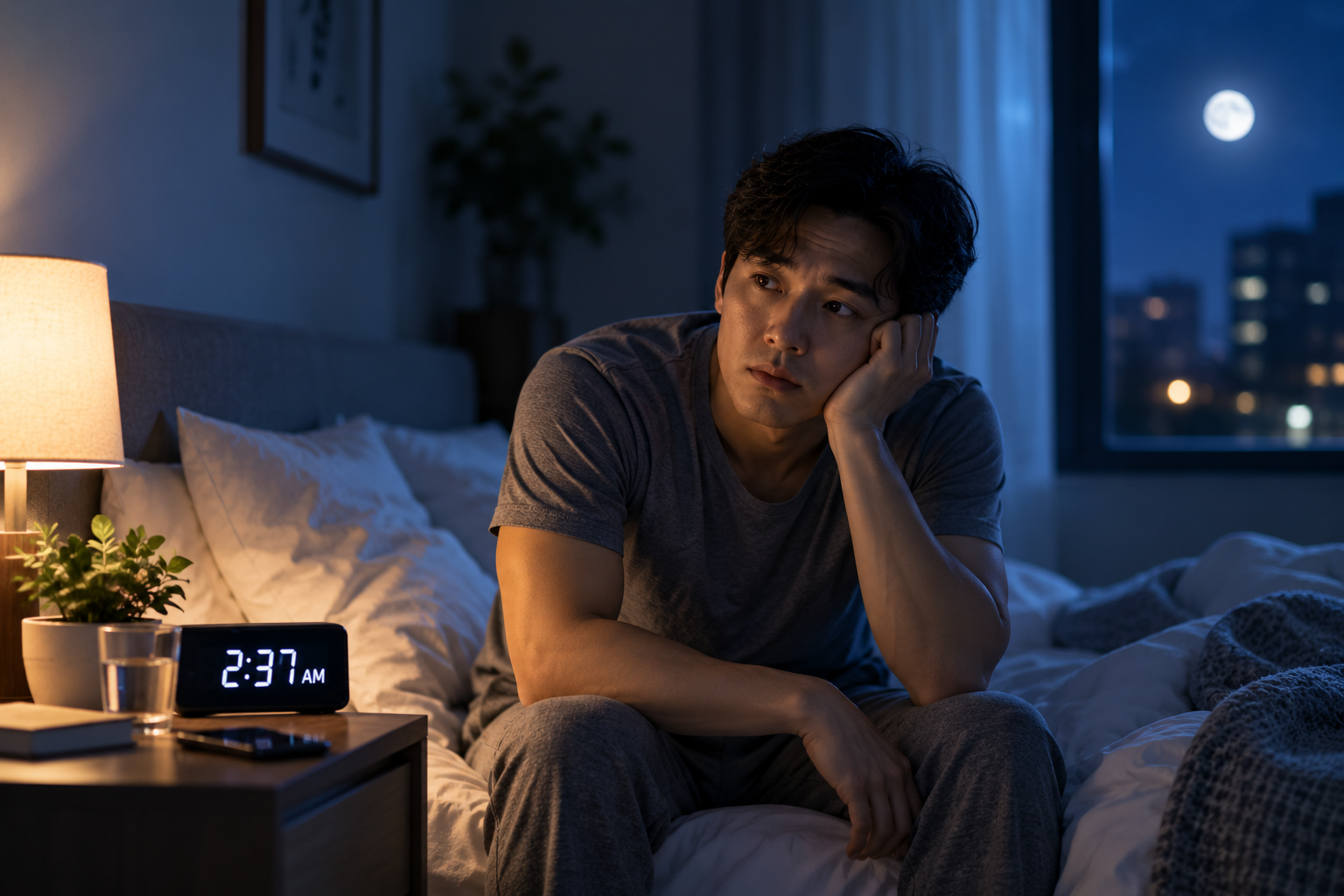
Why Do I Keep Waking Up at Night?
Waking up briefly during the night does not automatically mean that something is wrong with your sleep.
Sleep is not one continuous, unchanging state. Throughout the night, your brain and body move through different stages of sleep, and brief awakenings can occur.
The bigger question is what happens afterward.
Do you wake up repeatedly?
Do you stay awake for long periods?
Do you struggle to fall back asleep?
Or do you spend enough time in bed but still wake up feeling tired and unrefreshed?
Those patterns can tell you more about your sleep than simply counting the number of hours between bedtime and morning.
According to the Centers for Disease Control and Prevention, quality sleep is not only about getting enough hours. It should also be relatively uninterrupted and refreshing. Repeated nighttime awakenings can be one sign that sleep quality is not as good as it could be.
So if you regularly find yourself staring at the clock at 2:00 or 3:00 in the morning, it is worth looking beyond total sleep time.
Is It Normal to Wake Up During the Night?
Occasional awakenings can be part of normal sleep.
Your sleep architecture changes throughout the night as you cycle between non-REM and REM sleep. You may briefly become more aware of your surroundings during transitions without remembering it the next morning.
An awakening becomes more relevant when it happens frequently, lasts a long time, or leaves you feeling poorly rested during the day.
The National Heart, Lung, and Blood Institute lists frequently waking during the night, waking too early, and waking without feeling refreshed among symptoms that can occur with insomnia.
That does not mean everyone who wakes during the night has insomnia.
It means the frequency, duration, and daytime consequences matter.
Sleep Duration and Sleep Quality Are Different
You can spend eight hours in bed without necessarily getting eight hours of restorative sleep.
Imagine going to bed at 10:30 p.m. and getting up at 6:30 a.m.
On paper, that looks like eight hours.
But if you were awake for several extended periods during the night, your actual sleep experience may be very different.
This is why sleep duration and sleep quality should be considered together.
If you are unsure how much sleep adults generally need, our guide How Much Sleep Do You Really Need Each Night? explains the recommended range and why individual sleep needs can differ.
For most adults, experts generally recommend around 7 to 9 hours of sleep per night, but simply reaching that number does not guarantee that the sleep was restorative.
Why Do You Keep Waking Up at Night?
There is rarely one universal explanation.
Nighttime awakenings can be influenced by your environment, habits, schedule, stress level, substances such as caffeine or alcohol, and—in some cases—underlying sleep or medical conditions.
Instead of immediately assuming something serious is wrong, it can be useful to look at the simplest possibilities first.
Your Bedroom May Be Disturbing Your Sleep
Noise, light, and temperature can all interfere with sleep.
You may fall asleep easily when the house becomes quiet but wake later when traffic increases, another person moves around, a pet becomes active, or morning light begins entering the room.
Temperature matters too.
The NHLBI recommends keeping the bedroom quiet, cool, and dark as part of healthy sleep habits.
Consider what happens in your bedroom after you fall asleep—not just what the room feels like at bedtime.
A room that is dark at 11:00 p.m. may become bright at 5:30 a.m.
A quiet neighborhood in the evening may become noisy early in the morning.
Small environmental changes can sometimes make a meaningful difference.
Caffeine Can Affect Sleep Later Than You Expect
Many people associate caffeine only with difficulty falling asleep.
But its effects can extend well beyond the time you drink it.
Coffee, tea, energy drinks, cola, chocolate, and some medications can contain caffeine.
NHLBI notes that caffeine’s effects can last for several hours and recommends avoiding it close to bedtime. Its healthy sleep guidance notes that the effects may last as long as eight hours in some circumstances.
Sensitivity also varies considerably between individuals.
One person may drink coffee after dinner and sleep comfortably.
Another may notice poorer sleep after an afternoon coffee.
If you regularly wake at night, experimenting with an earlier caffeine cutoff can be more informative than assuming caffeine does not affect you simply because you fall asleep quickly.
Alcohol Can Make Sleep Feel Deceptive
Alcohol creates another interesting situation.
It may make some people feel sleepy and therefore seem helpful for falling asleep.
But falling asleep faster does not necessarily mean sleeping better.
NHLBI notes that although alcohol may make falling asleep easier, it can result in lighter sleep and make nighttime awakening more likely.
That distinction matters.
When evaluating your sleep, do not ask only:
“How quickly did I fall asleep?”
Also ask:
“How well did I stay asleep?”
Drinking Too Much Close to Bedtime
Sometimes the explanation is straightforward.
You wake because you need to use the bathroom.
Hydration is important, but consuming a large amount of fluid immediately before bed can make nighttime bathroom trips more likely.
NHLBI includes limiting fluids close to bedtime among strategies that may help some people sleep longer without needing to use the bathroom.
That does not mean deliberately dehydrating yourself.
Instead, consider distributing fluids more evenly throughout the day rather than trying to catch up immediately before bed.
Persistent or unusually frequent nighttime urination, however, may deserve discussion with a healthcare professional rather than simply restricting fluids.
Stress Can Follow You Into Bed
Your body can be tired while your mind remains active.
Work problems.
Family responsibilities.
Financial concerns.
Tomorrow’s schedule.
An unfinished conversation.
Sometimes these thoughts become most noticeable when the environment finally becomes quiet.
Stress does not always prevent you from initially falling asleep.
For some people, it becomes more noticeable after waking during the night.
You may wake briefly for an ordinary reason and then begin thinking.
Once that happens, returning to sleep becomes harder.
A predictable wind-down routine can help create a transition between daytime activity and sleep.
Our guide How to Sleep Better: Simple Habits for Better Rest covers practical strategies involving schedules, light, caffeine, screens, physical activity, and the bedroom environment.
Your Sleep Schedule May Be Inconsistent
The human body operates with internal timing systems that help regulate when you feel awake and when you feel sleepy.
Frequently changing your bedtime and wake time can work against that rhythm.
For example, you might wake at 6:30 a.m. throughout the workweek but sleep until 10:00 a.m. on weekends.
Then Sunday night arrives and you are surprised that you are not sleepy at your usual bedtime.
NHLBI recommends maintaining a consistent bedtime and wake time and keeping the difference between weekday and weekend schedules relatively small.
Perfect consistency is unrealistic for many people.
But large, frequent shifts can make sleep timing less predictable.
Naps Can Affect Nighttime Sleep
A nap can be useful when you are genuinely tired.
But timing and duration matter.
If you regularly struggle to sleep through the night, a long late-afternoon nap may reduce some of the sleep pressure that would otherwise build toward bedtime.
NHLBI advises people who have trouble falling asleep at night to consider limiting naps or taking them earlier in the afternoon.
Again, this does not mean naps are inherently bad.
Context matters.
Someone working unusual hours may use naps very differently from someone with a conventional daytime schedule.
Physical Activity Can Support Better Sleep
Regular physical activity is associated with many health benefits and can also be part of a healthy sleep routine.
NHLBI recommends being physically active during the day as one component of healthy sleep habits.
You do not necessarily need an intense workout.
Walking, resistance training, cycling, swimming, and other forms of movement can contribute to an active lifestyle.
If walking is your preferred activity, Is Walking 30 Minutes a Day Enough? explains how a simple daily walking routine can fit into broader physical activity recommendations.
The important point is that sleep and daytime behavior are connected.
What happens during the day can influence what happens at night.
Screens Are Not the Only Evening Problem
Phones often receive most of the blame for poor sleep.
Bright light from electronic devices can interfere with signals involved in the sleep-wake cycle, and both CDC and NHLBI recommend reducing bright electronic-device exposure before bedtime.
But the content you consume matters too.
Checking work messages, arguing online, reading stressful news, or watching highly stimulating content may not create an ideal transition into sleep.
Simply switching your phone to a warmer screen color does not necessarily turn an emotionally stimulating activity into a relaxing one.
Think about your entire pre-sleep environment, not just blue light.
Avoid Watching the Clock All Night
You wake at 2:17 a.m.
Then you check again.
2:38.
3:04.
3:21.
Now you are calculating:
“If I fall asleep immediately, I can still get three hours and nine minutes.”
That calculation rarely makes the situation more relaxing.
If clock-checking makes you increasingly frustrated or anxious, turning the clock away or keeping the phone out of immediate reach may help remove one source of stimulation.
The goal is not to force yourself to sleep.
Sleep is not something most people can command on demand.
Instead, create conditions that make sleep more likely.
Don’t Try Too Hard to Force Sleep
This sounds contradictory, but trying aggressively to sleep can make being awake feel like a problem that must be solved immediately.
That can increase frustration.
If nighttime awakenings happen occasionally, you do not necessarily need to analyze every one.
Keep the environment dark and quiet.
Avoid immediately reaching for stimulating content.
Give yourself an opportunity to settle again.
If persistent insomnia is the problem, however, simply accumulating more “sleep hacks” may not be enough.
NHLBI identifies cognitive behavioral therapy for insomnia (CBT-I) as a treatment option for long-term insomnia.
That is an important distinction between general sleep-hygiene advice and treatment for a persistent sleep disorder.
Could It Be Insomnia?
Insomnia is more than having one bad night.
NHLBI describes insomnia as difficulty falling asleep, staying asleep, or getting good-quality sleep despite having adequate opportunity and an appropriate environment for sleep.
Chronic insomnia generally involves symptoms occurring at least three nights per week for more than three months and not being fully explained by another health problem.
If you wake occasionally during a stressful week, that is different from months of persistent sleep difficulty affecting your daytime life.
Duration and impact matter.
What About Sleep Apnea?
Repeated awakenings can sometimes be related to a sleep disorder rather than ordinary sleep habits.
Sleep apnea is one example.
Not everyone who wakes during the night has sleep apnea, and nighttime awakening alone cannot diagnose it.
But symptoms such as loud frequent snoring, waking while gasping or feeling short of breath, significant daytime sleepiness, or repeatedly waking unrefreshed are worth discussing with a healthcare professional.
NHLBI specifically includes questions about loud snoring and waking while gasping or feeling out of breath when clinicians evaluate sleep problems.
This is an area where individualized evaluation is more appropriate than self-diagnosis.
Keep a Sleep Diary
If you cannot identify why you are waking, a simple sleep diary can reveal patterns that memory misses.
For one or two weeks, consider recording:
- when you went to bed
- approximately when you fell asleep
- nighttime awakenings
- when you woke in the morning
- naps
- caffeine and alcohol
- exercise
- how rested you felt the next day
CDC and NHLBI both describe sleep diaries as tools that can help characterize sleep problems.
You may discover that poor nights consistently follow late caffeine.
Or alcohol.
Or long naps.
Or unusually late meals.
Or a major change in your schedule.
Patterns give you something specific to work with.
Start With One Change
When sleep is frustrating, it is tempting to change everything at once.
New mattress.
No caffeine.
No screens.
New supplements.
Earlier bedtime.
More exercise.
Meditation.
Blackout curtains.
A completely new evening routine.
The problem is that if your sleep improves, you will not know what helped.
Instead, identify the most obvious issue and change that first.
Perhaps your bedroom is bright.
Fix the light.
Perhaps you drink coffee at 5:00 p.m.
Move it earlier.
Perhaps your wake time varies by four hours across the week.
Make it more consistent.
Simple experiments are easier to maintain and evaluate.
When Should You Talk to a Healthcare Professional?
Occasional sleep disruption is common.
Persistent sleep problems are different.
CDC recommends speaking with a healthcare provider if you regularly have difficulty sleeping or notice signs or symptoms of a sleep disorder.
Consider seeking professional guidance if nighttime awakenings are frequent and persistent, significantly affect daytime alertness or functioning, or occur alongside symptoms such as loud snoring, gasping, breathing difficulty, or other concerning symptoms.
A healthcare professional can also review medications and medical conditions that may affect sleep.
The answer is not always another bedtime habit.
Sometimes the underlying reason needs to be identified.
The Daily Bearings Takeaway
So, why do you keep waking up at night?
There is no single answer.
Your sleep environment, caffeine, alcohol, fluids, stress, naps, inconsistent schedules, and other everyday factors can all influence how well you stay asleep.
Occasional awakenings do not automatically mean you have a sleep problem.
What matters more is whether awakenings are frequent, prolonged, and affecting how rested and functional you feel during the day.
Start with the basics.
Keep your bedroom quiet, dark, and comfortable.
Maintain a reasonably consistent sleep schedule.
Pay attention to caffeine and alcohol.
Stay active during the day.
And look for patterns rather than trying a dozen sleep remedies at once.
Most importantly, remember that sleep quality matters alongside sleep quantity.
Seven or eight hours in bed does not tell the whole story.
Move. Breathe. Nourish.
This article is for general educational purposes and is not a substitute for individualized medical advice. If you have a medical condition, disability, or concerns about beginning a new exercise or nutrition routine, consider discussing appropriate changes with a qualified healthcare professional.
References
Centers for Disease Control and Prevention — About Sleep
CDC guidance on sleep quality, healthy sleep habits, sleep disorders, and sleep diaries.
National Heart, Lung, and Blood Institute — Healthy Sleep Habits
NIH/NHLBI guidance on sleep schedules, caffeine, light, bedroom environment, physical activity, and naps.
National Heart, Lung, and Blood Institute — Insomnia
NIH/NHLBI information about difficulty falling asleep or staying asleep, chronic insomnia, evaluation, and treatment.