How to Improve Balance as You Age
Balance is easy to take for granted.
You use it when you get out of bed, step into the shower, walk across an uneven sidewalk, climb stairs, carry groceries, or turn quickly when someone calls your name.
Most of these movements happen without much thought—until balance begins to feel less automatic.
The good news is that balance is not simply something you either have or lose.
Balance can be trained.
Muscle strength, coordination, vision, sensation, mobility, and the nervous system all contribute to your ability to stay steady. Regular physical activity that challenges these systems can help maintain physical function as you get older.
For adults age 65 and older, the Centers for Disease Control and Prevention recommends a combination of aerobic activity, muscle-strengthening activity, and activities that improve balance.
But improving balance does not require spending hours standing on one leg.
It starts with understanding what balance actually involves—and training it in ways that translate to everyday life.
What Is Balance?
Balance is your ability to maintain control of your body while standing still or moving.
That sounds simple, but your body is constantly combining information from several systems.
Your eyes help determine where you are relative to your surroundings.
Your inner ear helps detect movement and changes in head position.
Sensory information from your feet, joints, and muscles tells your brain where your body is positioned.
Your nervous system processes that information.
Then your muscles make continuous adjustments to keep you upright.
That means balance is not controlled by one muscle or one joint.
It is a whole-body skill.
Why Can Balance Change With Age?
Aging does not automatically mean becoming unstable.
However, several factors that contribute to balance can change over time.
Muscle strength may decline.
Reaction speed can change.
Vision or hearing may become less sharp.
Joint mobility may decrease.
Some medications can cause dizziness or drowsiness.
Certain health conditions can also affect sensation, gait, blood pressure, or the systems involved in maintaining balance.
The National Institute on Aging notes that factors including muscle loss, balance or gait problems, some medical conditions, medications, vision and hearing changes, foot problems, and environmental hazards can contribute to falls.
This is why balance should not be viewed as an isolated problem.
Sometimes improving it means strengthening your legs.
Sometimes it means practicing coordination.
Sometimes it means changing your environment.
And sometimes persistent balance problems require medical evaluation.
Strength and Balance Work Together
One of the most important things to understand about balance is that it depends partly on strength.
Imagine beginning to lose your balance.
Your body has to react quickly enough—and produce enough force—to recover.
Strong legs, hips, and trunk muscles can help you control your body during everyday movements.
The National Institute on Aging explains that muscle-strengthening exercise can improve physical function and make activities such as standing from a chair, climbing stairs, and carrying groceries easier.
This is why balance training should not completely replace strength training.
They complement each other.
If you are beginning resistance exercise, How to Start Strength Training at Home provides a practical starting point.
Mobility Matters Too
Balance also depends on being able to move effectively.
For example, limited ankle movement may change how you respond when your body shifts forward or backward.
Limited hip mobility may make stepping or changing direction more difficult.
But mobility is more than simply being flexible.
It involves having usable movement that you can control.
Our guide Mobility vs. Flexibility: What’s the Difference and Why Does It Matter? explains why having a large range of motion is different from being able to control that range.
For balance, usable movement matters.
You need enough mobility to respond—and enough strength and coordination to control the response.
Walking Is Helpful, but It Is Not the Whole Picture
Walking is an excellent form of physical activity.
It supports cardiovascular fitness, keeps you moving, and provides repeated practice coordinating your body while moving through space.
But walking on a predictable, flat surface may not challenge every aspect of balance.
Balance becomes more demanding when you:
change direction,
step over something,
walk on an uneven surface,
move sideways,
shift your weight,
or briefly reduce your base of support.
That does not mean you need to deliberately walk somewhere dangerous.
It means a complete activity routine can include both regular walking and controlled balance challenges.
CDC recommends that adults 65 and older include aerobic activity, muscle strengthening, and balance-improving activities each week rather than relying on only one type of exercise.
Start With a Stable Environment
Balance exercises should challenge you.
They should not unnecessarily expose you to a fall.
If you are new to balance training, practice near something stable such as:
a sturdy kitchen counter,
a heavy chair,
a wall,
or a secure railing.
Avoid relying on lightweight furniture that could move if you suddenly grab it.
The goal is to have support available without necessarily using it constantly.
As your balance improves, you may gradually depend on that support less.
NIA recommends having a sturdy chair, wall, or another person nearby when appropriate and moving slowly and mindfully during balance exercises.
Exercise 1: Sit to Stand
One of the most practical exercises is something you already do every day.
Sit in a stable chair.
Place your feet comfortably on the floor.
Lean slightly forward and stand.
Then lower yourself back into the chair with control.
Repeat.
The exercise trains more than leg strength.
It also requires you to shift your center of mass, coordinate your body, and control the transition between sitting and standing.
If necessary, begin by using your hands for assistance.
Over time, you may be able to rely on them less.
The objective is not speed.
The objective is controlled movement.
Exercise 2: Weight Shifts
Stand near a counter or another secure support.
Place your feet about hip-width apart.
Slowly shift more of your body weight toward one leg without lifting the other foot.
Return to the center.
Then shift toward the opposite side.
This is a very simple exercise, but weight shifting is fundamental to movement.
Every step requires you to transfer weight from one leg to the other.
As the exercise becomes easier, you can gradually make the shift more deliberate while maintaining good control.
Exercise 3: Heel-to-Toe Standing
Stand near a stable surface.
Place one foot in front of the other so that the heel of the front foot is close to the toes of the back foot.
Hold the position while remaining tall.
Then switch sides.
A narrower stance reduces your base of support and makes balance more challenging.
If placing the feet directly heel-to-toe is too difficult, begin with them slightly farther apart.
Progression matters more than forcing the hardest version immediately.
Exercise 4: Heel-to-Toe Walking
Once the standing version feels comfortable, you can practice moving.
Walk slowly along a clear path, placing one foot in front of the other.
Keep a wall or counter nearby if you need support.
The National Institute on Aging lists heel-to-toe walking among examples of balance exercises.
Move slowly enough that you remain in control.
This is balance practice—not a race.
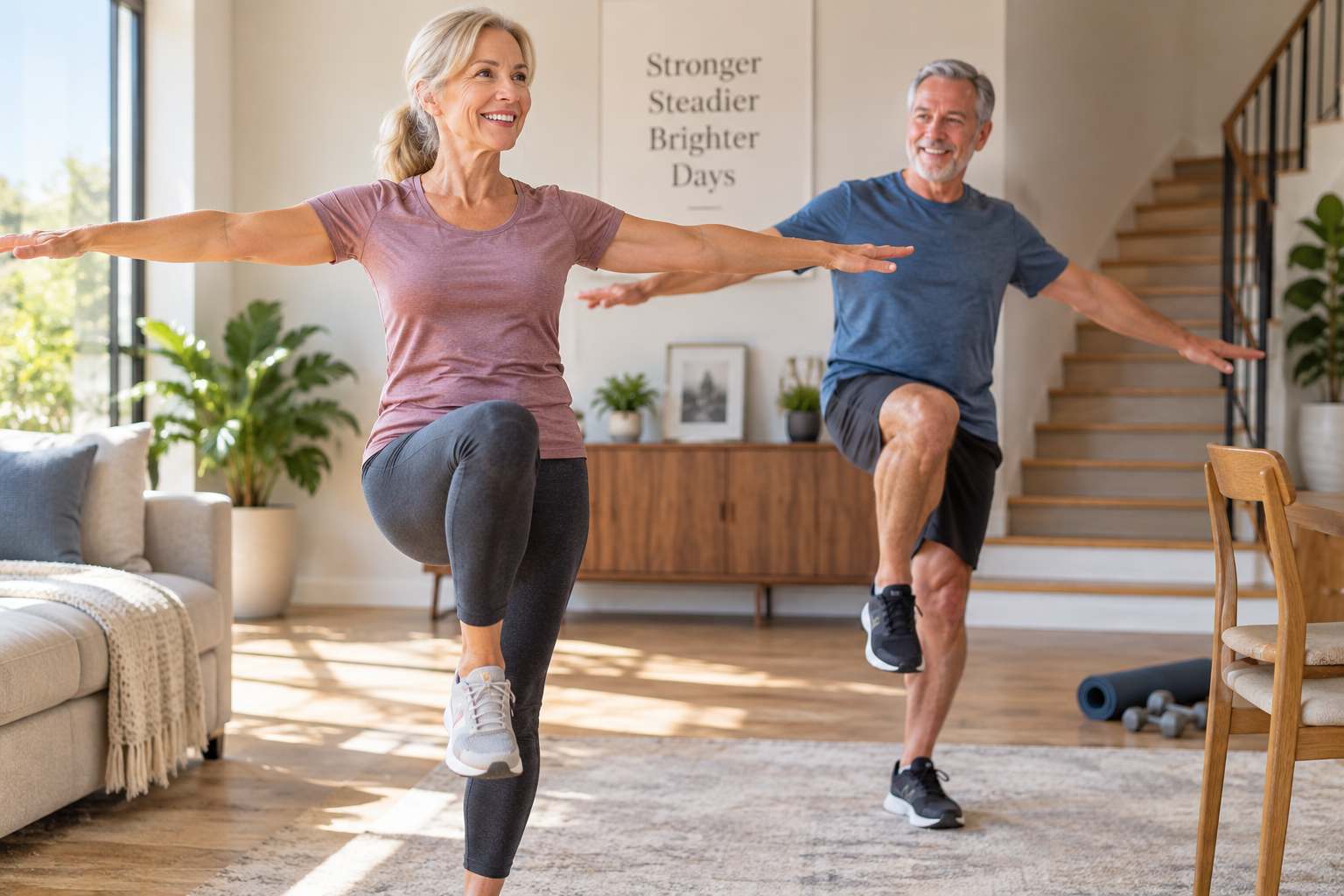
Exercise 5: Single-Leg Standing
Stand next to a sturdy support.
Shift your weight onto one leg.
Lift the other foot slightly from the floor.
Hold briefly.
Then switch sides.
At first, you may need to keep one or both hands on the support.
That is fine.
As you improve, you might progress from two hands to one hand, then to a fingertip, and eventually to no support when appropriate.
CDC includes standing on one foot as an example of a balance-improving activity for older adults.
You do not need to chase an impressive time.
Quality and safety matter more.
Exercise 6: Controlled Direction Changes
Everyday movement rarely happens only in a straight line.
You turn in the kitchen.
Step sideways around furniture.
Back away from a counter.
Change direction while walking.
Practicing these movements under controlled conditions can add useful variety.
Near a stable support, practice a few slow steps sideways.
Return.
Then practice changing direction deliberately rather than pivoting abruptly.
More advanced individuals may incorporate backward walking in an appropriate safe environment.
NIA includes backward and sideways walking among examples of balance activities.
If these movements make you feel unsafe or unusually dizzy, stop rather than trying to push through them.
How Often Should You Practice Balance?
Balance training does not have to be a long workout.
Short sessions can be incorporated into your week.
NIA suggests aiming for about three sessions of balance exercise per week, while CDC’s guidance for adults 65 and older recommends including balance activities as part of the weekly activity mix.
For example, you might spend several minutes on balance exercises after walking or strength training.
Consistency is more useful than occasionally doing a very difficult balance workout.
Make Exercises Harder Gradually
Balance improves when the challenge is appropriate.
If an exercise is so easy that your body barely has to adjust, there may eventually be little reason for further adaptation.
But if the exercise is so difficult that you repeatedly lose control, the risk may outweigh the benefit.
Progress gradually.
Depending on the exercise and your ability, progression might mean:
using less hand support,
narrowing your stance,
holding a position slightly longer,
moving more slowly and deliberately,
or adding controlled movement.
You do not need to use every progression.
The best challenge is one you can perform safely.
Don’t Close Your Eyes Just to Make It Harder
You may see balance routines that recommend closing your eyes.
Removing visual information certainly makes balance more difficult.
But more difficult does not automatically mean more appropriate.
For someone who already feels unstable, closing the eyes can substantially increase the challenge and potentially the risk of falling.
There are many safer ways to progress first.
Use less hand support.
Improve single-leg control.
Practice controlled stepping.
Build leg strength.
Unless you are working in an appropriate supervised setting, there is usually no need to turn a simple balance exercise into a high-risk test.
Tai Chi Can Combine Movement and Balance
Balance training does not have to consist only of isolated drills.
Activities such as tai chi can combine controlled movement, weight shifting, coordination, and balance.
CDC specifically identifies tai chi as an example of an activity that can strengthen the legs and improve balance in fall-prevention guidance.
Yoga and some forms of dance can also challenge multiple physical abilities simultaneously.
The best activity is not necessarily the most complicated one.
It is one that appropriately challenges you and that you are willing to continue.
Your Home Environment Matters
Exercise is only one part of fall prevention.
A strong, active person can still trip over an unsecured rug.
Look around the places where you move every day.
Are walkways clear?
Are electrical cords crossing frequently used paths?
Is there adequate lighting at night?
Are stairs easy to see?
Are rugs secure?
Is the bathroom slippery?
NIA recommends measures such as improving lighting, securing carpets, and installing appropriate bathroom grab bars as part of reducing fall risk.
This illustrates an important principle:
Fall prevention is not only about making your body more capable. It is also about making your environment safer.
Shoes Can Affect Stability
Footwear changes how you interact with the ground.
Loose, unstable, or poorly fitting shoes may make movement more difficult.
NIA identifies unsafe footwear and foot problems as factors that can contribute to falls.
Choose footwear appropriate for the activity and environment.
And if foot pain changes the way you walk, consider addressing the cause rather than simply accepting the altered gait.
Vision, Hearing, and Medications Matter
Not every balance problem can be solved with exercise.
Vision and hearing contribute to how you navigate your environment.
Some medications may also cause dizziness, sleepiness, or other effects that increase fall risk.
NIA recommends regular vision and hearing checks and discussing medication side effects with a healthcare professional as part of fall prevention.
Do not stop a prescribed medication because you suspect it affects your balance.
Instead, discuss the concern with your doctor or pharmacist.
Standing Up Too Quickly Can Be Different From Poor Balance
Sometimes a person says:
“My balance is bad when I stand up.”
But the sensation may actually be dizziness or lightheadedness after changing position.
NIA notes that blood pressure that drops excessively when standing—often called postural or orthostatic hypotension—can contribute to falls.
That is different from simply needing stronger balance skills.
If you frequently become dizzy or lightheaded when standing, especially if symptoms are new or significant, medical evaluation is more appropriate than trying to fix the problem with increasingly difficult balance exercises.
Balance Training Should Support Everyday Life
The purpose of balance training is not to become exceptionally good at balance exercises.
It is to make real movement easier and more confident.
Getting out of a chair.
Walking outside.
Climbing stairs.
Carrying groceries.
Moving around the house.
Stepping over a curb.
Recovering from a small misstep.
These are the outcomes that matter.
Physical activity can improve physical function and help older adults continue performing everyday activities and living independently.
That connects directly with our guide How to Stay Independent as You Age.
Independence is supported by many abilities working together—strength, mobility, endurance, balance, confidence, and an environment that allows you to use them.
A Simple 10-Minute Balance Routine
A basic session does not need to be complicated.
Begin with a few controlled sit-to-stands.
Practice gentle side-to-side weight shifts.
Move into heel-to-toe standing.
Try several controlled heel-to-toe steps.
Practice supported single-leg standing on each side.
Finish with slow sideways stepping or another comfortable movement challenge.
Rest whenever needed.
Keep a stable support nearby.
The exact number of repetitions or seconds is less important than performing each movement safely and with control.
As your ability improves, gradually increase the challenge rather than simply adding more and more exercises.
When Should You Get Professional Help?
A balance exercise article cannot determine why an individual is unsteady.
Talk with a healthcare professional if you experience persistent or worsening balance problems, unexplained falls, significant dizziness, fainting, sudden changes in walking, or other concerning symptoms.
A doctor may evaluate possible contributing factors or recommend assessment by another professional, such as a physical therapist.
NIA specifically recommends medical evaluation when someone believes they may have a balance problem.
This is particularly important when instability is new rather than a gradual change you have noticed over time.
The Daily Bearings Takeaway
So, how can you improve balance as you age?
Start by recognizing that balance is a skill involving much more than standing on one leg.
Strength matters.
Mobility matters.
Coordination matters.
Vision, sensation, and your environment matter.
Regular walking keeps you active, while strength training gives your body more capacity to control movement. Specific balance exercises add another layer by challenging stability, weight shifting, and coordination.
You do not need extreme exercises.
Start near a stable support.
Practice simple movements consistently.
Progress gradually.
And address environmental and medical factors that exercise alone cannot solve.
The goal is not perfect balance.
The goal is to maintain the physical ability and confidence to keep moving through everyday life.
Move. Breathe. Nourish.
This article is for general educational purposes and is not a substitute for individualized medical advice. If you have a medical condition, disability, or concerns about beginning a new exercise or nutrition routine, consider discussing appropriate changes with a qualified healthcare professional.
References
Centers for Disease Control and Prevention — Older Adult Activity: An Overview
Current CDC recommendations for aerobic, muscle-strengthening, and balance activities for adults age 65 and older.
National Institute on Aging — Three Types of Exercise Can Improve Your Health and Physical Ability
NIA guidance and examples for aerobic, muscle-strengthening, and balance exercise.
National Institute on Aging — Falls and Fractures in Older Adults: Causes and Prevention
Information about fall risk factors, physical activity, strength, balance, footwear, medications, and home safety.